250A vs 180A Welders: Which Should You Buy?
As an Amazon Associate we earn from qualifying purchases. Links on this page are affiliate links.
Choosing between a 250A vs 180A welder depends on your specific project needs. Both units offer dual-voltage input for flexibility in home or shop settings. They share synergic MIG technology to simplify beginner operation. The main difference lies in their maximum output capacity. One model provides 250A for heavier fabrication, while the other offers 180A with a more comprehensive starter kit. This affects the thickness of materials you can weld effectively.
Key differences
| Aspect | YESWELDER 250A Dual-Voltage Multi-Process Welder | TOOLIOM 180A 4-in-1 Dual-Voltage Welder |
|---|---|---|
| Amperage | 250A | 180A |
| Welding Processes | 6-in-1 (MIG, Pulsed MIG, Flux Core, Spool Gun MIG, Lift TIG, Stick) | 4-in-1 (Gas MIG, Flux MIG, Stick, Lift TIG) |
| Included Kit | Not listed | Includes gloves, flux wire, MIG torch, Lift TIG torch, gas hose |
| Stick Mode Features | Not listed | Hot Start, Arc Force, VRD, Anti-Stick |
Which one should you choose?
Choose YESWELDER 250A Dual-Voltage Multi-Process Welder if
- You need to weld thicker steel or aluminum using a spool gun.
- You want the highest possible amperage for industrial-style fabrication.
- You plan to use pulsed MIG for better control on thin metals.
Choose TOOLIOM 180A 4-in-1 Dual-Voltage Welder if
- You are a beginner who wants a complete kit ready to weld immediately.
- You primarily work with carbon steel and stainless steel up to moderate thicknesses.
- You need adjustable Stick welding parameters like Arc Force and Hot Start.
Verdict: The 250A model suits professionals or serious hobbyists needing higher power and spool gun capability for aluminum. The 180A unit is better for beginners or DIYers who want a complete, ready-to-use package with versatile Stick settings.
250A vs 180A Welder Comparison
Amperage Output
The YESWELDER model delivers a robust 250A output, providing significant power for heavier fabrication tasks. This higher amperage allows you to weld thicker materials with greater ease and penetration. The TOOLIOM unit offers a maximum of 180A. While sufficient for many home and automotive projects, this lower limit may restrict your ability to work with thick steel plates efficiently. If you frequently tackle heavy-duty construction or industrial repair work, the 250A capacity provides a clear performance advantage. However, for lighter DIY jobs, the 180A output remains fully capable without unnecessary power overhead.
Welding Processes
Process versatility differs notably between these two machines. The YESWELDER advertises a 6-in-1 configuration, supporting MIG, Pulsed MIG, Flux Core, Spool Gun MIG, Lift TIG, and Stick welding. This broad range covers almost every common application, including aluminum welding via spool gun. The TOOLIOM machine provides 4-in-1 functionality, covering Gas MIG, Flux MIG, Stick, and Lift TIG. It lacks dedicated Spool Gun MIG or Pulsed MIG modes in its standard description. If you need to weld aluminum or require pulsed settings for thin metals, the YESWELDER offers more options. Otherwise, both handle standard steel welding well.
Material Compatibility
Both welders handle carbon steel and stainless steel effectively using solid and flux-core wires. The YESWELDER explicitly supports .023”, .030”, and .035” wires for MIG and Lift TIG, plus .035” and .045” magnesium and silicon aluminum wires for spool gun applications. This specific mention of aluminum wire compatibility expands its material scope. The TOOLIOM machine lists compatibility with .023”, .030”, and .035” solid wires, and .030” and .035” flux-cored wires for carbon and stainless steel. It does not explicitly list aluminum wire support. For general steel work, both are equal. For aluminum projects, the YESWELDER provides broader compatibility.
Input Voltage
Both units feature dual-voltage input capabilities, accepting 110V and 220V power sources. This flexibility allows you to plug them into standard household outlets or shop power circuits. The TOOLIOM model includes auto-recognition for 110V/220V input, simplifying setup as you do not need to manually switch settings. The YESWELDER also supports dual voltage but does not explicitly mention auto-recognition in the provided data. For most users, this difference is minor, as both adapt to common electrical environments. You can use either machine in a garage or on a job site without worrying about power source limitations. This aspect results in a tie for practical usability.
Control Features
Control precision varies between the two models. The TOOLIOM unit offers manual MIG mode with inductance control ranging from -10 to +10, allowing fine-tuning of the arc characteristics. Its Stick mode includes adjustable Hot Start (0–10), Arc Force (0–10), VRD, and Anti-Stick functions. The YESWELDER provides manual MIG mode with voltage fine-tuning between -3V and 3V. It mentions dynamic arc control but does not list specific inductance or Stick-mode adjustments like Hot Start. If you value detailed control over arc force and stick welding parameters, the TOOLIOM offers more granular settings. For basic MIG tuning, both provide adequate manual adjustments.
Which Welder Fits Your Needs
Heavy fabrication and thick metal workers
The YESWELDER model delivers a robust 250A output, providing significant power for heavier fabrication tasks. This higher amperage allows you to weld thicker materials with greater ease and penetration. It supports spool gun MIG welding for aluminum, making it ideal for automotive repair and construction projects requiring deep fusion and high throughput on steel plates.
Beginners wanting a complete starter kit
The TOOLIOM unit comes as a complete kit, including gloves, flux core wire, and a Lift TIG torch. This 4-in-1 design offers Gas MIG, Flux MIG, Stick, and Lift TIG modes out of the box. It features synergic MIG technology for easy setup and a 60% duty cycle at 180A, ensuring stable performance for DIY projects without needing extra purchases.
Users needing precise professional control
The TOOLIOM welder includes manual MIG mode with full control over wire feed speed, voltage, and inductance ranging from -10 to +10. Its Stick mode offers adjustable Hot Start, Arc Force, and VRD functions. These professional-grade controls allow you to customize settings for different materials and joint types, providing the precision needed for varied metalworking workshops.
Quick picks
| # | Product | Best for | Price |
|---|---|---|---|
| 1 | YESWELDER 250A Dual-Voltage Multi-Process Welder | Heavy-duty fabrication and multi-process work | Check price of YESWELDER 250A Dual-Voltage Multi-Process Welder on Amazon |
| 2 | TOOLIOM 180A 4-in-1 Dual-Voltage Welder | DIYers needing versatile MIG and Stick welding | Check price of TOOLIOM 180A 4-in-1 Dual-Voltage Welder on Amazon |
The products compared
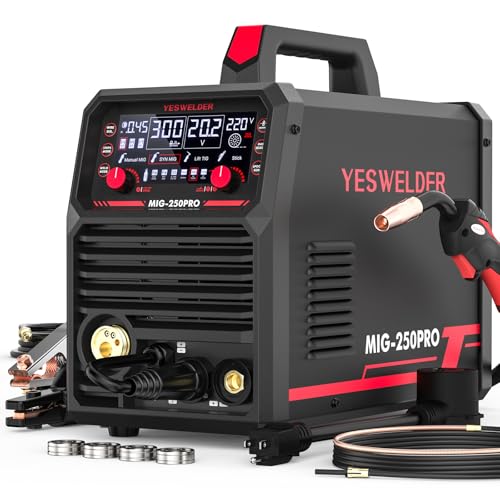
YESWELDER 250A Dual-Voltage Multi-Process Welder
Best for: Heavy-duty fabrication and multi-process work
- Amperage
- 250A (what this guide is about)
- Welding Process
- TIG, Stick, MIG, Flux Core
- Input Voltage
- Dual Voltage
- Material
- Aluminum
- Features
- Pulse, Spool Gun, Digital Display
View on Amazon: YESWELDER 250A Dual-Voltage Multi-Process Welder Affiliate link
The YESWELDER 250A is a dual-voltage MIG welder offering 250A output for heavy-duty fabrication. It supports six processes, including MIG, flux core, and lift TIG. The unit features synergic and manual modes, a digital display, and protections against overheating. It suits users needing high amperage for automotive or construction work who require versatile process options.
Pros
- 250A output for thick materials
- 6-in-1 multi-process capability
- Synergic MIG for beginners
- Digital display for clear monitoring
- Dual 110V/220V input voltage
Cons
- Lift TIG torch not included
- Spool gun not included
- Heavier build than 180A models
Good fit if
- You need high amperage for thick steel
- You want multiple welding processes in one unit
- You work with both 110V and 220V power
Skip if
- You only need basic stick welding
- You require a portable, lightweight tool
- You want a complete kit with all torches
Verdict: YESWELDER 250A 6-in-1 MIG Welder fits professionals needing high power and process variety, though you must buy additional torches separately.

TOOLIOM 180A 4-in-1 Dual-Voltage Welder
Best for: DIYers needing versatile MIG and Stick welding
- Amperage
- 180A (what this guide is about)
- Welding Process
- TIG, Stick, MIG
- Input Voltage
- Dual Voltage
- Features
- Synergic Control
- Dimensions
- 7.09 × 12.4 × 18.3 inches
View on Amazon: TOOLIOM 180A 4-in-1 Dual-Voltage Welder Affiliate link
The TOOLIOM 180A MIG Welder offers dual voltage input for 110V or 220V use. It supports Gas MIG, Flux MIG, Stick, and Lift TIG processes. Synergic MIG technology syncs voltage with wire feed speed. You get manual control over inductance, hot start, and arc force. The 60% duty cycle at 180A allows longer continuous work. This kit includes a Lift TIG torch, gloves, and wire for immediate use.
Pros
- 4-in-1 capability: Gas MIG, Flux MIG, Stick, and Lift TIG
- Dual voltage input (110V/220V) with auto-recognition
- Synergic MIG mode auto-syncs voltage to wire feed speed
- Manual MIG mode allows inductance tuning from -10 to +10
- 60% duty cycle at 180A for extended welding sessions
Cons
- 180A output is lower than the 250A option on this list
- Includes Lift TIG torch only; does not support AC TIG
- No pulse welding capability listed for aluminum or thick materials
Good fit if
- You need a versatile machine for home DIY and automotive repairs
- You want synergic MIG for easier, beginner-friendly operation
- You require a complete kit with torches and wire included
Skip if
- You frequently weld thick steel requiring higher amperage
- You need pulse MIG for aluminum welding
- You require AC TIG for aluminum or stainless steel
Verdict: TOOLIOM 180A 4-in-1 MIG Welder fits hobbyists and DIYers who need a versatile, all-in-one kit for light to medium gauge steel. It is not the right tool for professionals needing high-amperage pulse welding or AC TIG capabilities.
Specifications side by side
| Spec | YESWELDER 250A Dual-Voltage Multi-Process Welder | TOOLIOM 180A 4-in-1 Dual-Voltage Welder |
|---|---|---|
| Welding Process | TIG, Stick, MIG, Flux Core | TIG, Stick, MIG |
| Amperage | 250A | 180A |
| Input Voltage | Dual Voltage | Dual Voltage |
| Material | Aluminum | not stated |
| Features | Pulse, Spool Gun, Digital Display | Synergic Control |
| Dimensions | not stated | 7.09 × 12.4 × 18.3 inches |
| Size | MIG-250PRO | 180A MIG Welder |
| Color | Black, Red | not stated |
| Model | MIG-250DS PRO | MIG-180 PRO |
Frequently asked questions
Is a 250A welder too powerful for home use?
A 250A unit is not too powerful for home use if you have the right setup. The YESWELDER 250A model features dual-voltage input, allowing it to operate on standard household circuits. This flexibility lets you tackle heavy-duty fabrication in a garage without needing industrial power lines. It provides significant power for thicker materials when needed.
Can a 180A welder handle steel fabrication?
Yes, a 180A welder can handle light to medium gauge steel fabrication. The TOOLIOM 180A model supports MIG and TIG processes, making it versatile for DIYers. While it lacks the high-amperage pulse welding of larger units, it is sufficient for general hobbyist projects and lighter structural work. It offers a complete kit for immediate use.
What is the difference between MIG and TIG on these machines?
The primary difference lies in the welding process supported by each machine. The YESWELDER 250A focuses on MIG welding, ideal for speed and thick metals. The TOOLIOM 180A supports both MIG and TIG, offering more versatility for different materials. TIG provides greater precision for aluminum or stainless steel, while MIG is faster for steel.
Do I need separate torches for these welders?
You may need to purchase additional torches depending on the model. The YESWELDER 250A requires you to buy torches separately, which adds to the initial setup. The TOOLIOM 180A is described as an all-in-one kit, suggesting it includes necessary accessories. Check the specific package contents to ensure you have the correct torch for your chosen process.
Which welder is better for beginners?
The TOOLIOM 180A is often better for beginners due to its versatility and included kit. It supports both MIG and TIG processes, allowing you to learn multiple techniques. The YESWELDER 250A is more complex, targeting professionals who need high power. Beginners may find the 180A unit easier to manage for light to medium projects without extra purchases.
Can these welders run on 110V power?
Yes, both welders support dual-voltage input, which includes 110V operation. This feature allows you to use them in standard home outlets. The YESWELDER 250A and TOOLIOM 180A both offer this flexibility. Running on lower voltage may limit maximum output, but it provides convenience for shop or garage settings without requiring specialized electrical installations.
Is the 250A model suitable for aluminum welding?
The YESWELDER 250A is primarily a MIG welder, which can weld aluminum with a spool gun. The data notes it fits professionals needing high power. However, it does not explicitly list AC TIG capabilities. For dedicated aluminum work, the TOOLIOM 180A’s TIG support might be more suitable, as TIG is the preferred method for clean aluminum welds.
What size is the 180A welder?
The TOOLIOM 180A has specific dimensions for portability. It measures 12.4 inches in width, 18.3 inches in height, and 7.09 inches in length. These compact dimensions make it easy to store in a small workshop or transport to job sites. The YESWELDER 250A size is not specified in the provided data.