Generators Buying Guide (2026): What Matters and 8 Picks
As an Amazon Associate we earn from qualifying purchases. Links on this page are affiliate links.
Choosing the right power source requires careful evaluation of wattage, fuel type, and portability. This generator buying guide helps you navigate those choices by focusing strictly on published specifications. You will learn how to match output capacity and fuel flexibility to your specific needs, whether for whole-home backup or RV camping.
We selected 8 models based on their technical data and practical application. The list includes options ranging from heavy-duty tri-fuel units to lightweight inverters. Each pick is ranked by its ability to deliver reliable power under defined conditions. You can compare dimensions, weight, and safety features to find the best fit for your situation. The goal is to help you make a clear decision without guesswork.
Our top pick: DuroMax 13,000-Watt Dual Fuel Generator.
What to look for in generators
Wattage capacity
Wattage determines how many appliances you can run at once. You must match the generator's output to your peak load. The DuroMax 13,000-Watt Dual Fuel Generator provides reliable high-capacity power for homeowners who need to run essential appliances during extended outages. Inverter models like the WEN 4800-Watt Portable Inverter Generator offer lower output but cleaner power for sensitive electronics. Choose high wattage for whole-home backup. Choose lower wattage for camping or RV use. Higher output often means more weight and fuel consumption.
- Running watts vs starting watts
- Peak load requirements
- Surge capacity for motors
Fuel type flexibility
Fuel options affect availability and storage. Tri-fuel models like the Generac 12,500W Tri-Fuel Generator with EFI suit homeowners needing reliable high-wattage backup with flexible fuel options. You can switch between propane, gasoline, and natural gas. Dual-fuel units like the DuroMax offer gasoline or propane. Standard gas generators are simpler but rely on one fuel source. Propane stores indefinitely but has lower energy density. Gasoline is widely available but degrades over time. Select a fuel type that matches your emergency preparedness strategy and local availability.
- Supported fuel types
- Fuel tank capacity
- Run time per gallon
Inverter technology
Inverter generators produce clean sine wave power. This is critical for sensitive electronics like laptops and medical devices. The WEN 4800-Watt Portable Inverter Generator offers reliable clean power with safety features. It fits RV owners and those needing quiet backup for small electronics. Standard open-frame generators may damage delicate circuits. Inverter models are quieter and more fuel-efficient at partial loads. They are lighter and more portable. However, they usually have lower maximum wattage. Choose inverter technology for electronics and quiet operation needs.
- Pure sine wave output
- Noise level in dB
- Efficiency at low load
Safety sensors
Carbon monoxide sensors are vital for indoor or semi-enclosed use. The Westinghouse 4650W Gas Generator with CO Sensor suits RV campers who value safety sensors. The Westinghouse 13500W Tri-Fuel Portable Generator includes a CO Sensor for added protection. These sensors shut down the unit if dangerous gas levels are detected. This feature prevents poisoning in garages or near windows. Always verify if the sensor is integrated or add-on. Integrated sensors are more reliable. Prioritize this feature for home backup in tight spaces.
- Integrated CO sensor
- Low oil shutdown
- Overload protection
Portability and weight
Weight affects how easily you can move the unit. The Oxseryn 4400W Gas Inverter Generator is lightweight at 56 pounds. It suits campers who value quiet, lightweight power over high capacity. Heavy units like the DuroMax 13,000-Watt Dual Fuel Generator weigh 245 pounds. They require wheels and handles for movement. Consider your storage space and carrying ability. Portable models fit in car trunks. Stationary models stay in garages. Match the weight to your physical capability and intended use case.
- Total unit weight
- Wheel and handle kit
- Dimensions for storage
Start mechanism
Starting methods vary from manual recoil to electric start. The WEN 4800-Watt Portable Inverter Generator includes an electric start option. Electric start is convenient for older users or in bad weather. Manual recoil requires physical effort. Some models offer remote start for added convenience. The Westinghouse 10000W Open Frame Inverter Generator suits users who need remote start convenience. Electric start adds cost and weight. Manual start is simpler and more reliable in extreme cold. Choose based on your physical ability and convenience needs.
- Electric start availability
- Remote start option
- Recoil pull strength
Outlet configuration
Outlets determine what you can plug in directly. The Westinghouse 10000W Open Frame Inverter Generator is transfer-switch-ready for home integration. The DuroMax 13,000-Watt Dual Fuel Generator has a robust outlet configuration. Check for 120V AC, 12V DC, and USB ports. High-amperage outlets like 50-amp require specific cables. Ensure you have the right adapters for your devices. More outlets mean more flexibility. Fewer outlets keep the unit compact. Match the outlet types to your essential loads.
- Number and type of outlets
- Amperage per outlet
- Transfer switch compatibility
Generator Types By Output
High-capacity stationary
These units deliver over 12,000 watts for whole-home backup. The DuroMax XP13000HX weighs 245 pounds and measures 30 inches long. It supports dual fuel options for extended runtime. The Generac 8061 offers 12,500 watts with electronic fuel injection. It weighs 227 pounds and includes a 50-amp outlet. These models suit homeowners needing reliable power during long outages. They are heavy and require a permanent or semi-permanent setup. You sacrifice portability for maximum output and fuel flexibility.
Tri-fuel portable
Tri-fuel generators run on gasoline, propane, or natural gas. The Westinghouse WGen10500TFc provides 13,500 watts and weighs 230 pounds. It measures 27.2 inches long and includes a carbon monoxide sensor. This type offers significant fuel flexibility for extended emergencies. You can switch fuels based on availability or storage convenience. The weight makes manual transport difficult without assistance. These units are ideal for users who value backup duration over easy mobility. They bridge the gap between portable and stationary power sources.
Inverter generators
Inverter generators produce clean power for sensitive electronics. The WEN 56480iX weighs 77 pounds and measures 23.8 inches long. It includes a carbon monoxide alarm and electric start. The Oxseryn EDOG10 is lighter at 56 pounds. It measures 19 inches long and outputs 4,400 watts. These models are quiet and compact, making them ideal for RV camping. They suit users who need to power laptops or medical devices. The main trade-off is lower wattage compared to open-frame units. You gain portability and clean power at the cost of peak capacity.
Common Generator Buying Mistakes
Ignoring surge wattage requirements
You must check both running and surge watts. Motors in welders and tools need extra power to start. If you only match running watts, the generator will shut down when you try to ignite the arc or start the motor. Always add a 20 to 50 percent buffer for startup spikes.
Overlooking fuel type flexibility
Some units run on gas, propane, or diesel. Choose a dual-fuel model if you need backup options. Propane burns cleaner and stores longer without stabilizers. Gas offers higher energy density for heavy loads. Match the fuel type to your site availability and storage capabilities to ensure you never run out during critical work.
Assuming portability is equal
High-wattage generators often weigh over 200 pounds. Check the weight and dimensions before buying. Large units may require a cart or dolly for movement. Smaller inverter models are lighter but cost more. Plan your worksite layout to ensure you can actually move the unit to where you need power most often.
Neglecting noise output levels
Generators can be loud, affecting site communication and compliance. Check the decibel rating at a specific load, usually 25 percent or 50 percent. Lower noise models use sound-dampening enclosures or inverter technology. If you work in residential areas or need quiet operation, prioritize decibel specs over raw wattage capacity to avoid complaints or fines.
Quick picks
Our 8 picks

DuroMax 13,000-Watt Dual Fuel Generator
Best for: Whole-home backup power and high-wattage needs
- Application
- Home
- Dimensions
- 30 × 29 × 26 inches
- Weight
- 245 pounds
The DuroMax XP13000HX delivers 13,000 watts of power using a 500cc OHV engine with all-copper windings. It runs on gasoline or propane, allowing you to switch fuel types via a front-facing interface. This 245-pound unit includes electric push-button start and a transfer-switch-ready 50-amp outlet. It suits homeowners needing whole-home backup during storms or outages.
Pros
- 13,000-watt output for whole-home power needs
- Dual fuel capability with gasoline or propane
- Transfer-switch-ready 50-amp outlet included
- CO Alert safety feature to detect harmful fumes
Cons
- Heavy 245-pound build limits portability
- Large footprint measures 30 by 29 inches
- No remote start or app control listed
Good fit if
- You need high wattage for whole-home backup
- You want to switch between gasoline and propane
- You require a transfer-switch-ready 50-amp outlet
Skip if
- You need a lightweight unit for easy transport
- You prefer inverter technology for quiet operation
- You want remote start or smart app control
Verdict: DuroMax 13,000-Watt Dual Fuel Generator provides reliable high-capacity power for homeowners who need to run essential appliances during extended outages. Its dual-fuel design and robust outlet configuration make it a solid choice for stationary backup use.
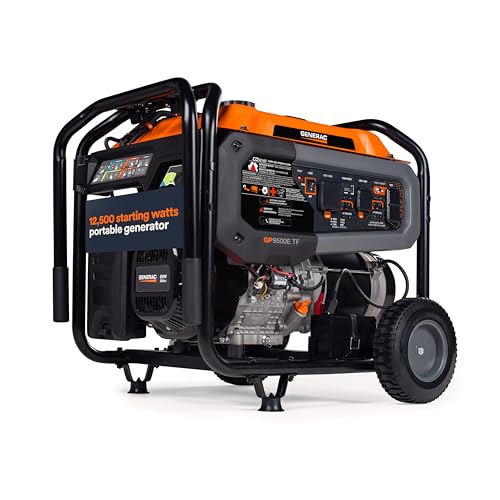
Generac 12,500W Tri-Fuel Generator with EFI
Best for: Whole-home backup with fuel flexibility
- Application
- Home
- Dimensions
- 27.2 × 26.9 × 27 inches
- Weight
- 227 pounds
This Generac unit delivers 12,500 starting watts on gasoline and runs on propane or natural gas. It features electronic fuel injection for efficiency and CO Sense technology for safety. The 7.5-gallon tank provides up to 14 hours of runtime. You get electric start with recoil backup and a 50-amp outlet. It weighs 227 pounds on a steel cradle with never-flat wheels.
Pros
- Tri-fuel capability with single-dial switching
- CO Sense automatic shutdown technology
- Electronic fuel injection reduces maintenance
- 120/240V 50A NEMA 14-50R outlet included
- 14-hour runtime on gasoline at 25% load
Cons
- Heavy 227-pound build requires two people
- Shorter runtime on propane compared to gasoline
- No remote control or app connectivity listed
Good fit if
- You need high power for whole-home backup
- You want flexibility with fuel sources
- You prioritize safety with CO detection
Skip if
- You need a lightweight portable unit
- You require remote start capabilities
- You only use propane fuel
Verdict: Generac 12,500 Watt Tri-Fuel Generator suits homeowners needing reliable high-wattage backup with flexible fuel options and integrated safety monitoring. It is ideal for those who can manage its substantial weight and value the convenience of a 50-amp connection.
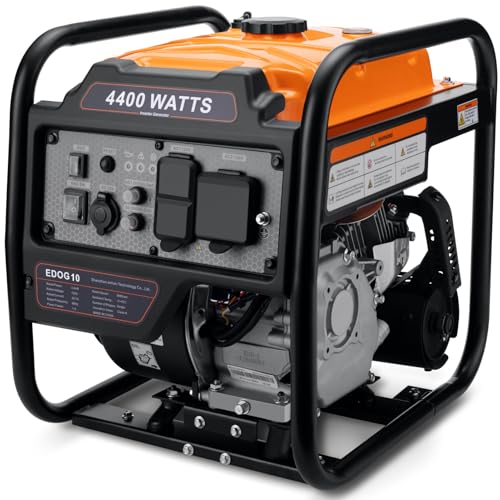
Oxseryn 4400W Gas Inverter Generator
Best for: RV camping and light home backup needs
- Application
- Home
- Dimensions
- 19 × 15.6 × 19.1 inches
- Weight
- 56 pounds
This Oxseryn inverter generator delivers 4400 peak watts and 3400 running watts for home backup or RV use. It weighs 56 pounds and measures 15.6 by 19 by 19.1 inches. The unit runs up to 14 hours at 25% load using ECO mode. It operates under 72 dBA from 23 feet away. You get two 120V AC ports, one 12V DC port, and an RV outlet.
Pros
- 4400 peak watts and 3400 running watts output
- Runs up to 14 hours at 25% load with ECO mode
- Weighs only 56 pounds for easy portability
- Noise level under 72 dBA from 23 feet away
Cons
- Lower wattage compared to 10,000+ watt competitors on this list
- Only a 2-gallon fuel tank limits runtime at higher loads
- No electric start feature listed in specifications
Good fit if
- You need a lightweight power source for RV camping
- You want quiet operation for home backup situations
- You only need to run a few essential devices
Skip if
- You require high wattage for whole-home backup
- You prefer electric start convenience for heavy units
- You need to power large appliances like central AC
Verdict: Oxseryn 4400W Portable Inverter Generator suits campers who value quiet, lightweight power over high capacity. It is not suitable for users needing to run multiple high-draw appliances simultaneously.

WEN 4800-Watt Portable Inverter Generator
Best for: RVs and sensitive electronics
- Dimensions
- 23.8 × 12.6 × 22 inches
- Weight
- 77 pounds
This WEN inverter generator delivers 4800 surge watts and 4000 rated watts from a 224cc engine. It weighs 77 pounds and measures 23.8 by 12.6 by 22 inches. The unit includes electric start, recoil backup, and a CO shutdown sensor. It provides clean power for sensitive electronics. It suits RV users and homeowners needing quiet, lightweight backup power for small loads.
Pros
- 4800 surge watts and 4000 rated watts output
- Produces clean power for sensitive electronics
- Includes keyless electric start and recoil backup
- Built-in CO shutdown sensor for safety
Cons
- Lower wattage than many competitors on this list
- Heavier than typical inverter models
- No dual fuel capability in this specific configuration
Good fit if
- You need clean power for laptops and phones
- You value a built-in carbon monoxide sensor
- You want electric start convenience
Skip if
- You require high wattage for heavy appliances
- You need dual fuel flexibility
- You prioritize the lightest possible unit
Verdict: WEN 4800W Inverter Generator offers reliable clean power with safety features. It fits RV owners and those needing quiet backup for small electronics.

Westinghouse 13500W Tri-Fuel Portable Generator
Best for: Home backup with tri-fuel flexibility
- Application
- Home
- Dimensions
- 27.2 × 26.1 × 26.5 inches
- Weight
- 230 pounds
View on Amazon: Westinghouse 13500W Tri-Fuel Portable Generator
This Westinghouse unit delivers 13,500 peak watts on gasoline, 12,500 on propane, and 10,000 on natural gas. It features a 500cc engine with a cast iron sleeve and remote electric start. The 9.5-gallon tank supports up to 19 hours of runtime. You get multiple outlets, including a transfer switch-ready 30A socket and an RV-ready 50A socket. It weighs 230 pounds and includes a remote key fob and tool kit for setup.
Pros
- Tri-fuel capability with 13,500 peak watts on gasoline
- Remote electric start with included key fob
- Transfer switch ready with 30A L14-30R outlet
- RV-ready 50A 120/240V outlet included
- Up to 19 hours runtime on a 9.5-gallon tank
Cons
- Heavy at 230 pounds, making portability difficult
- Large footprint at 27.2 inches in length
- No Bluetooth or smartphone app connectivity listed
Good fit if
- You need a high-capacity generator for home backup
- You want the flexibility of propane or natural gas
- You require a transfer switch-ready outlet for panels
Skip if
- You need a lightweight unit for easy transport
- You prefer a smaller generator for camping
- You require app-based remote monitoring
Verdict: Westinghouse 13500W Tri-Fuel Portable Generator is a robust power source for homeowners needing reliable backup. It suits those who value fuel flexibility and high output over portability.

Oxseryn 5000W Gas Inverter Generator
Best for: RV camping and sensitive electronics backup
- Dimensions
- 19 × 15 × 18.5 inches
- Weight
- 59 pounds
The Oxseryn 5000W Inverter Generator delivers 5000 peak watts and 4000 running watts from a 223CC engine. It features inverter technology for clean power with low THD, protecting sensitive electronics. The unit weighs 59 pounds and offers a 10-hour runtime at 25% load. It includes a 30A RV port and two 120V AC outlets. This model suits RV camping, emergency home backup, and powering tools while keeping noise levels low.
Pros
- 5000 peak watts and 4000 running watts output
- Inverter technology provides clean power with low THD
- 10-hour runtime at 25% load with a 2-gallon tank
- Lightweight 59-pound design for easy transport
- Quiet operation at 70 dBA from 23 feet
Cons
- Lacks electric start; requires manual pull-start
- High-altitude kit is not included for use above 4000 feet
- Open frame design offers less protection than enclosed models
Good fit if
- You need clean power for sensitive electronics like laptops
- You require a 30A RV port for camping trips
- You want a lightweight unit under 60 pounds
Skip if
- You need electric start for quick operation
- You require high-altitude performance without extra parts
- You need more than 5000 peak watts
Verdict: The Oxseryn 5000W Inverter Generator fits users who prioritize clean power and portability for RVing or light home backup. It is a practical option for those who do not mind manual starting and standard altitude conditions.

Westinghouse 10000W Open Frame Inverter Generator
Best for: home backup with transfer-switch-ready outlets
- Dimensions
- 24 × 26.7 × 25.1 inches
- Weight
- 148 pounds
View on Amazon: Westinghouse 10000W Open Frame Inverter Generator
This Westinghouse portable inverter generator delivers 7,600 running watts and 10,000 peak watts on gasoline. It features a 420cc engine with a cast iron sleeve and a VFT digital display showing voltage, frequency, and hours. You get remote electric start with a key fob, push button, and recoil options. The unit includes four GFCI household outlets and two transfer-switch-ready ports. It runs up to 12 hours on a 5.28-gallon tank.
Pros
- 10,000 peak watts and 7,600 running watts on gasoline
- Remote electric start with included key fob
- VFT digital display for real-time voltage and frequency monitoring
- Transfer-switch-ready 120/240V and 120V outlets
- Low oil shutdown and automatic low oil protection
Cons
- 148 pounds is heavier than many inverter competitors
- Open frame design offers less noise reduction than enclosed models
- No carbon monoxide sensor listed in specifications
Good fit if
- You need transfer-switch-ready outlets for home backup
- You prefer remote start convenience with a key fob
- You want real-time voltage and frequency data on a display
Skip if
- You require a carbon monoxide sensor for safety
- You need a quieter enclosed inverter design
- You prioritize a lighter weight under 100 pounds
Verdict: Westinghouse 10000W Open Frame Inverter suits users who need transfer-switch-ready power and remote start convenience. It is a solid choice for home backup where voltage monitoring and heavy-duty outlets matter more than portability.
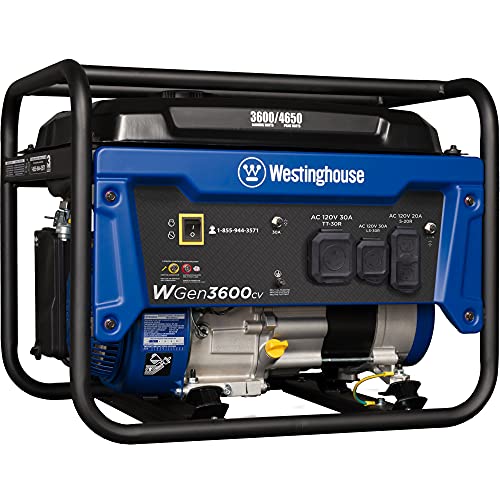
Westinghouse 4650W Gas Generator with CO Sensor
Best for: RV camping and essential home backup power
- Dimensions
- 23.3 × 17.5 × 18.7 inches
- Weight
- 101 pounds
View on Amazon: Westinghouse 4650W Gas Generator with CO Sensor
This Westinghouse unit delivers 3600 running watts and 4650 peak watts for RV and home backup needs. It features a 212cc engine with a 4-gallon tank, offering up to 14 hours of run time. Safety is prioritized with automatic low oil and carbon monoxide shutdowns. The 101-pound frame includes RV-ready and household outlets. It requires minimal assembly and comes with necessary tools and oil.
Pros
- Provides 3600 running watts and 4650 peak watts
- Runs for up to 14 hours on a 4-gallon tank
- Includes automatic CO and low oil shutdown sensors
- Features RV-ready TT-30R and L5-30R outlets
Cons
- Heavy at 101 pounds, making portability difficult
- Uses recoil start instead of electric start
- Gas only configuration lacks dual-fuel flexibility
Good fit if
- You need reliable power for RV camping trips
- You want automatic safety shutdowns for indoor-adjacent use
- You prefer a straightforward gas-powered unit
Skip if
- You require electric start for easy ignition
- You need dual-fuel options for propane backup
- You want a lighter unit under 80 pounds
Verdict: Westinghouse 4650 Peak Watt Portable Generator suits RV campers who value safety sensors and long run times over electric start convenience.
Specifications side by side
| Spec | DuroMax 13,000-Watt Dual Fuel Generator | Generac 12,500W Tri-Fuel Generator with EFI | Oxseryn 4400W Gas Inverter Generator | WEN 4800-Watt Portable Inverter Generator | Westinghouse 13500W Tri-Fuel Portable Generator | Oxseryn 5000W Gas Inverter Generator | Westinghouse 10000W Open Frame Inverter Generator | Westinghouse 4650W Gas Generator with CO Sensor |
|---|---|---|---|---|---|---|---|---|
| Application | Home | Home | Home | not specified | Home | not specified | not specified | not specified |
| Dimensions | 30 × 29 × 26 inches | 27.2 × 26.9 × 27 inches | 19 × 15.6 × 19.1 inches | 23.8 × 12.6 × 22 inches | 27.2 × 26.1 × 26.5 inches | 19 × 15 × 18.5 inches | 24 × 26.7 × 25.1 inches | 23.3 × 17.5 × 18.7 inches |
| Weight | 245 pounds | 227 pounds | 56 pounds | 77 pounds | 230 pounds | 59 pounds | 148 pounds | 101 pounds |
| Color | Blue | Orange | Orange | Black | Blue | Orange | Blue | Blue |
| Model | XP13000HX | 8061 | EDOG10 | 56480iX | WGen10500TFc | OXOG08 | ecoGen10000 | WGen3600cv |
| Size | not specified | not specified | not specified | Fuel: Standard + Electric Start + Safety: CO Alarm | 13000W Tri-Fuel + CO Sensor | not specified | not specified | not specified |
If you need to power workshop ventilation, use our fan buying guide to compare airflow ratings and power draw.
Frequently asked questions
Can I use a generator for whole-home backup?
Yes, high-capacity units are designed for this purpose. The DuroMax XP13000HX and Generac 8061 provide over 12,000 watts to power essential appliances. These models feature robust outlet configurations, such as 50-amp connections, to integrate with your home’s transfer switch. They are stationary units, so you must plan for their significant weight and dimensions.
What is the difference between dual fuel and tri fuel generators?
Fuel flexibility allows you to switch between gasoline and propane, or add natural gas. The DuroMax XP13000HX supports dual fuel, while the Generac 8061 and Westinghouse WGen10500TFc offer tri-fuel options. This lets you choose the most available fuel source during an outage. It extends runtime and reduces reliance on a single fuel type.
Are inverter generators safe for sensitive electronics?
Inverter generators produce clean power, which is safer for delicate devices. The WEN 56480iX and Oxseryn models provide stable output for RVs and small electronics. They are lighter and quieter than open-frame units. However, their lower wattage limits them to light loads, making them unsuitable for running multiple high-draw appliances simultaneously.
How heavy are portable generators?
Weight varies significantly by type and power output. Inverter models like the Oxseryn EDOG10 weigh around 56 pounds, making them easy to move. High-capacity home units are much heavier. The DuroMax XP13000HX weighs 245 pounds, and the Generac 8061 weighs 227 pounds. You need a sturdy cart or dolly for these large units.
Do generators come with safety sensors?
Many modern units include built-in safety features. The Westinghouse WGen10500TFc has a CO sensor, and the WEN 56480iX includes a CO alarm. These sensors detect dangerous carbon monoxide levels and shut down the engine automatically. This adds a layer of protection when operating the generator in enclosed or semi-enclosed spaces like garages.
What size generator do I need for RV camping?
A 4,000 to 5,000-watt inverter generator is usually sufficient. The Oxseryn EDOG10 (4400W) and OXOG08 (5000W) are ideal for RVs. They are lightweight and quiet. They provide clean power for electronics and small appliances. If you need more capacity, the Westinghouse WGen3600cv offers reliable power with a CO sensor for safer operation on the road.
What are the dimensions of large home backup generators?
High-capacity units are bulky. The DuroMax XP13000HX measures 30 inches long, 29 inches wide, and 26 inches high. The Generac 8061 is slightly more compact at 27.2 inches long. The Westinghouse WGen10500TFc measures 27.2 inches long. Ensure you have adequate space for ventilation and access to fuel tanks and outlets before installation.