What Is Power Source? A Guide for Welders Buyers (2026)
As an Amazon Associate we earn from qualifying purchases. Links on this page are affiliate links.
Power Source Explained for Welders
The power source defines how a welding machine generates the energy needed to create an arc. This spec is critical because it determines where and how you can operate your equipment. You generally choose between two main types: engine-driven units and battery-powered tools. Understanding the difference helps you match the machine to your job site requirements.
Engine-driven welders contain an internal combustion engine, typically running on gasoline or diesel. This setup allows the machine to operate independently of any electrical grid. You can take these units to remote construction sites, rural repair jobs, or outdoor locations without access to mains power. The engine spins a generator that produces the electricity for welding. These machines often provide higher amperage outputs, making them suitable for heavy-duty tasks and thicker materials. However, they require regular maintenance, such as oil changes and fuel management. They are also heavier and produce noise and exhaust fumes.
Battery-powered welders use rechargeable lithium-ion packs to store energy. This technology offers maximum portability and convenience. You can weld anywhere, from tight spaces inside vehicles to elevated structures, without cords or generators. The power source is self-contained within the tool itself. These units are ideal for light to medium-duty work, such as maintenance, fabrication, or automotive repair. They operate quietly and produce zero emissions at the point of use. The main limitation is runtime. You must monitor the battery charge level and have spare packs ready for continuous work. Charging time also affects your workflow efficiency.
When shopping, look for the power source label in the specifications. Engine-driven models will list engine type and fuel capacity. Battery models will show voltage and amp-hour ratings. Your choice depends on your need for mobility versus raw power. If you work off-grid, an engine-driven unit is likely necessary. If you need quick, clean repairs, a battery-powered option offers superior convenience.
Engine Driven vs Battery Options
Engine Driven
Engine-driven welders use an internal combustion motor to generate power. This setup allows for continuous operation without worrying about battery recharge cycles. You get consistent output suitable for thick materials and long jobs. The trade-off is significant weight and maintenance needs. You must manage fuel, oil, and regular engine checks. These units are ideal for fieldwork where grid power is unavailable. For example, the Tomahawk Power 15 HP unit provides 210 amps and serves as a generator. It weighs 202 pounds, so you need a sturdy transport method. The ESAB Renegade VOLT cover protects Big Blue models, highlighting the bulk of these machines. If you prioritize raw power and runtime over portability, this is your choice.
Battery Powered
Battery-powered welders rely on rechargeable lithium-ion packs for energy. This design eliminates exhaust fumes and reduces noise levels significantly. You gain superior portability since the unit is lighter and cordless. However, you are limited by battery capacity and runtime. You must carry spare batteries for extended tasks. This option suits mobile welders who value clean operation and quick setup. The ESAB Renegade VOLT Stick and TIG Welder weighs 90 pounds. Its compact dimensions of 19 x 19 x 9 inches make it easy to carry. You sacrifice some raw amperage for this mobility. If you work in tight spaces or need to move frequently, battery power offers the flexibility you require without the drag of an engine.
Is Power Source Worth Your Money
Who needs it
You should prioritize engine-driven power sources if your work takes you to remote job sites without access to grid electricity. These units generate their own power through an internal combustion engine, allowing for continuous operation. This independence is vital for construction, pipeline work, or field repairs where outlets are unavailable. You get consistent output suitable for thick materials and long-duration jobs without interruption. The ability to run for hours makes this the only viable choice for heavy industrial tasks far from infrastructure. If your daily routine involves moving between distant locations or working in areas with no electrical service, this spec defines your operational capability. You need this freedom to keep welding regardless of the surrounding environment.
Who can skip it
You can likely ignore engine-driven complexity if you primarily weld in a fixed workshop or near reliable electrical outlets. Battery-powered options offer sufficient power for most general fabrication, maintenance, and light repair tasks in these controlled environments. These units are lighter and quieter, making them easier to handle and store. You save time on fuel management and maintenance associated with engines. Instead of focusing on autonomous power generation, prioritize portability, ease of use, and clean operation. If your work stays within reach of standard power sources, the added weight and noise of an engine are unnecessary burdens. Focus on arc stability and duty cycle rather than how the power is generated. Your time is better spent on technique than managing fuel levels.
Welder Power Source Glossary
Amperage
The electrical current flowing through the arc. Higher amperage allows you to weld thicker materials. It is the primary measure of a machine’s welding capacity.
Input Voltage
The power required to run the welder. Common options are 110-volt for standard outlets or 220-volt for higher performance. Match this to your site’s electrical supply.
Wattage
The total power consumption of the unit. It indicates the load placed on your electrical circuit. Higher wattage means more energy usage during operation.
Current Type
Whether the machine outputs alternating or direct current. Direct current is standard for most metals. Alternating current is often used for aluminum welding processes.
Welding Process
The specific method used to join metals. Common types include MIG, TIG, and stick welding. Your chosen process determines the compatible consumables and machine settings.
Material Compatibility
The types of metal the welder can handle. Most units work on steel, but some require specific settings for aluminum or stainless steel. Check the specs for your needs.
Application
The intended use case for the equipment. This ranges from light home repair to heavy industrial fabrication. Your application dictates the required duty cycle and power output.
Features
Additional capabilities beyond basic welding. Examples include hot start, arc force, or digital displays. These features help improve weld quality and ease of use for you.
Quick picks
| # | Product | Best for | Price |
|---|---|---|---|
| 1 | VeyoStories Engine Driven Welder Cover | Big Blue 500/600/800 Pro engine-driven welders | Check price of VeyoStories Engine Driven Welder Cover on Amazon |
| 2 | ESAB Renegade VOLT Stick and TIG Welder | portable Stick and TIG welding tasks | Check price of ESAB Renegade VOLT Stick and TIG Welder on Amazon |
| 3 | Tomahawk Power 15 HP Engine Driven Welder Generator | Field welding requiring combined power generation | Check price of Tomahawk Power 15 HP Engine Driven Welder Generator on Amazon |
Our 3 picks

VeyoStories Engine Driven Welder Cover
Best for: Big Blue 500/600/800 Pro engine-driven welders
- Power Source
- Engine Driven (what this guide is about)
View on Amazon: VeyoStories Engine Driven Welder Cover Affiliate link
This is a protective cover for engine-driven welders, specifically sized for Big Blue 500, 600, and 800 Pro models. It measures 72 inches deep, 30 inches wide, and 50 inches high. The unit uses double-layer 600D Oxford fabric with a waterproof coating and UV-resistant materials. A plush-lined roof cushions against impacts. Two heavy-duty side buckles secure the cover in windy conditions.
Pros
- 72"D x 30"W x 50"H size fits Big Blue 500/600/800 Pro models
- Double-layer 600D Oxford fabric provides tear and abrasion resistance
- Waterproof and UV-resistant materials protect against rain, snow, and sun
- Plush-lined roof cushions against impacts
- Two heavy-duty side buckles secure the cover in strong winds
Cons
- Limited to specific engine-driven welder models; not universal for all brands
- No mention of ventilation features to prevent moisture buildup inside
- Only available in black color
Good fit if
- You own a Big Blue 500, 600, or 800 Pro engine-driven welder
- You need heavy-duty protection against harsh weather and abrasions
- You want a secure fit with adjustable buckles for windy conditions
Skip if
- You use a battery-powered welder or a different engine-driven brand
- You need a cover for a welder with different dimensions
- You prefer a ventilated cover to prevent condensation
Verdict: VeyoStories Engine Driven Welder Cover offers robust protection for Big Blue 500/600/800 Pro models with its durable 600D Oxford fabric and secure buckles. It is the right choice for owners of these specific engine-driven units who need reliable weather resistance.

ESAB Renegade VOLT Stick and TIG Welder
Best for: portable Stick and TIG welding tasks
- Power Source
- Battery Powered (what this guide is about)
- Welding Process
- TIG, Stick
- Dimensions
- 19 × 9 × 19 inches
- Weight
- 90 pounds
View on Amazon: ESAB Renegade VOLT Stick and TIG Welder Affiliate link
The ESAB Renegade VOLT ES 200i is a battery-powered welder for Stick and TIG processes. It delivers 200 A on AC mains and up to 140 A on battery. The unit includes four 12Ah DeWALT FLEXVOLT batteries. It weighs 90 pounds and measures 19 by 19 by 9 inches. This lightweight design suits users needing portability without an engine. It features an AMP+ hybrid mode for extra power.
Pros
- Delivers 200 A output on AC mains
- Includes four 12Ah DeWALT FLEXVOLT batteries
- Provides up to 140 A on battery power
- Lightweight 90-pound build for easy transport
- 80% efficiency at maximum current
Cons
- Battery output is limited to 140 A
- Requires separate AC power for 200 A
- No remote control included in data
Good fit if
- You need portable Stick and TIG welding
- You want to avoid engine maintenance
- You need to weld in areas without power
Skip if
- You require high-amperage welding on battery alone
- You prefer engine-driven units for heavy duty work
- You need integrated remote control for precision
Verdict: ESAB Renegade VOLT ES 200i Battery Welder offers versatile power options for mobile welders. It fits professionals who value portability and clean operation over raw battery amperage.
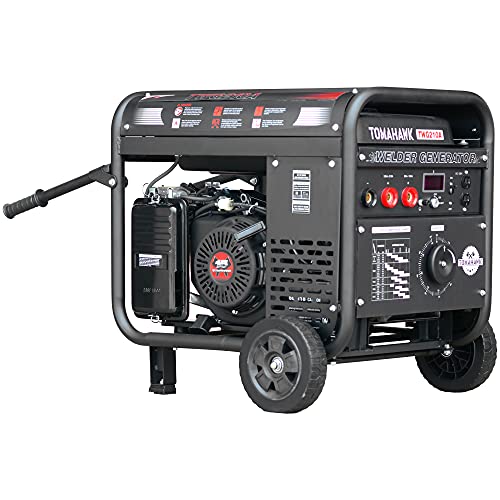
Tomahawk Power 15 HP Engine Driven Welder Generator
Best for: Field welding requiring combined power generation
- Power Source
- Engine Driven (what this guide is about)
- Welding Process
- TIG, Stick
- Dimensions
- 22 × 29 × 29 inches
- Weight
- 202 pounds
View on Amazon: Tomahawk Power 15 HP Engine Driven Welder Generator Affiliate link
This engine-driven unit combines a 15 HP generator with a 210 Amp stick and TIG welder. It features an inverter design for a stable sine wave, ensuring steady arc performance. You can weld materials up to 3/8 inch thick. The 60% duty cycle at 210 Amps allows for sustained work. It weighs 202 pounds and measures 29 by 29 by 22 inches, making it a substantial piece of equipment for field use.
Pros
- 210 Amps output with a 60% duty cycle
- Inverter generator provides stable sine wave
- Welds up to 3/8 inch thickness
- Electronic reader and knob for easy amperage setting
Cons
- Heavy at 202 pounds
- Large footprint at 29 inches wide and high
- Limited to stick and TIG processes only
Good fit if
- You need a single unit for welding and power generation
- You require stable arc performance for TIG work
- You are welding thick materials up to 3/8 inch
Skip if
- You prefer lightweight portable gear under 100 pounds
- You need plasma or MIG welding capabilities
- You have limited storage space for large equipment
Verdict: Tomahawk 15 HP 210 Amp Welder suits professionals needing reliable power and welding in one heavy package. It fits those prioritizing arc stability and thickness capacity over portability.
Specifications side by side
| Spec | VeyoStories Engine Driven Welder Cover | ESAB Renegade VOLT Stick and TIG Welder | Tomahawk Power 15 HP Engine Driven Welder Generator |
|---|---|---|---|
| Welding Process | not stated | TIG, Stick | TIG, Stick |
| Power Source | Engine Driven | Battery Powered | Engine Driven |
| Dimensions | not stated | 19 × 9 × 19 inches | 22 × 29 × 29 inches |
| Weight | not stated | 90 pounds | 202 pounds |
| Size | 72"D x 30" W x 50" H | not stated | 210 Amps + Kit |
| Color | Black | Multicolor | 210 Amps + Kit |
| Model | Engine Driven Welder Cover | 447800880 | TWG210A |
Frequently asked questions
Can a battery-powered welder handle thick steel?
Battery units like the ESAB Renegade VOLT offer versatile power for portable tasks. They fit professionals who value clean operation and mobility over raw output. While they excel in Stick and TIG processes, their amperage is lower than engine-driven models. You should choose them for thinner materials or light structural work where portability matters most.
Which power source is better for remote job sites?
Engine-driven welders are the best choice for remote locations without grid electricity. They generate their own power using an internal combustion engine, allowing for continuous operation. The Tomahawk Power 15 HP model provides 210 amps for field welding. This independence ensures you can weld thick materials anywhere without waiting for battery recharge cycles.
How heavy is a portable battery welder?
Portability varies by model, but battery units are generally lighter than engine-driven counterparts. The ESAB Renegade VOLT weighs 90 pounds, making it manageable for mobile welders. Its compact dimensions of 19 by 19 by 9 inches allow for easier transport. You can carry it to various job sites without needing a heavy-duty truck.
Do engine-driven welders produce more amperage?
Yes, engine-driven models typically offer higher amperage for demanding tasks. The Tomahawk Power unit delivers 210 amps, suitable for thick materials and long jobs. This consistent output is vital for professionals prioritizing arc stability. Battery-powered alternatives focus on portability and may not match this raw power capacity for heavy-duty industrial applications.
What size cover fits an engine-driven welder?
Engine-driven welders require larger protective covers due to their size and weight. The VeyoStories cover is designed for Big Blue 500/600/800 Pro models. It measures 72 inches deep, 30 inches wide, and 50 inches high. This robust fit ensures weather resistance for your equipment. You should verify your specific welder model matches these dimensions before purchasing.
Can I use a battery welder for TIG welding?
Certain battery-powered units support multiple welding processes, including TIG. The ESAB Renegade VOLT handles both Stick and TIG tasks. This versatility makes it ideal for professionals needing clean operation in various settings. You get the flexibility to switch processes without changing power sources, though output remains limited compared to larger engine-driven machines.