Stark USA Portable Spot Welder vs Stark USA 220V Portable Electric Spot Welder: Spec Comparison
As an Amazon Associate we earn from qualifying purchases. Links on this page are affiliate links.
When comparing the stark usa portable spot welder vs 220v portable electric spot welder, you see two handheld tools for sheet metal work. Both units use copper tips and simple lever operation. The main difference lies in their power input. One runs on standard 110V outlets, while the other requires 220V power. This voltage choice dictates where you can use each tool. Both are designed for light to heavy-duty fabrication tasks with similar ergonomic handles.
Key differences
| Aspect | Stark USA 110V Portable Spot Welder | Stark USA 220V Portable Spot Welder |
|---|---|---|
| Input Voltage | 110V | 220V |
| Rated Input Capacity | 1.5KVA | 2.5KVA |
| Maximum Output Current | 5500A | 6750A |
| Weight | not listed | 28.9 pounds |
| Included Extras | not listed | Extra welding tips |
Which one should you choose?
Choose Stark USA 110V Portable Spot Welder if
- You need to plug the unit into a standard 110V household outlet.
- You prefer a lighter, more compact tool for transport.
- You are working in locations without 220V power access.
Choose Stark USA 220V Portable Spot Welder if
- You require higher amperage for thicker metal sheets.
- You have access to a 220V power source.
- You want extra welding tips included for immediate replacement.
Verdict: The 110V model suits users with limited power access who need portability. The 220V model offers more power and includes spare tips for heavier jobs. Choose based on your available electrical outlet and the thickness of metal you weld most often.
Voltage and Power Comparison
Input Voltage
The first product operates on 110V input, making it compatible with standard household outlets in many residential settings. This allows for easier setup without requiring specialized electrical infrastructure. The second product requires a 220V input, which is common in industrial environments or workshops with dedicated circuits. You must ensure your workspace has the correct voltage before pl in either unit. Using the wrong voltage can damage the equipment. The 110V model offers greater accessibility for home users, while the 220V model targets professional shops with higher power demands.
Power Output
Power capacity differs significantly between the two units. The 110V model has a rated input capacity of 1.5KVA and delivers a maximum output current of 5500A. The 220V model is more powerful, featuring a 2.5KVA input capacity and a maximum output current of 6750A. Higher amperage allows for faster welding cycles and better penetration on thicker metals. If you frequently weld heavier gauge sheet metal, the higher current of the 220V unit provides a clear advantage in speed and consistency. The 110V unit is sufficient for lighter tasks.
Build Material
Both welders utilize copper for their welding tips, which ensures durable performance and reliable heat conduction during operation. Copper tips resist wear and maintain their shape longer than inferior materials. The second product explicitly lists steel as a material attribute, likely referring to the main body or structural components, suggesting a robust industrial build. The first product does not specify its body material in the provided data, though it mentions durable copper tips. Both designs prioritize longevity. You can expect consistent weld quality from the copper tips on either machine, assuming proper maintenance and tip replacement as needed.
Dimensions and Weight
Size and weight affect portability and ease of handling. The 110V model has specific dimensions listed as 5 inches in width, 9 inches in height, and 20 inches in length. It is described as lightweight and compact. The 220V model lists a weight of 28.9 pounds but does not provide dimensional measurements in the data. This weight suggests a substantial build, which may impact how easily you can move it around a job site. The 110V unit appears more compact, potentially offering better maneuverability for tight spaces or extended handheld use without fatigue.
Included Accessories
Accessories can impact your initial setup and ongoing costs. The 220V model comes with an extra pair of welding tips included in the package. This allows you to have spare tips ready for quick replacement when the original ones wear out. The 110V model description does not mention additional tips or accessories in the provided data. Having spare tips is practical for continuous work. You may need to purchase replacement tips separately for the 110V unit. This inclusion gives the 220V model a slight practical advantage for immediate usability.
Which spot welder fits your needs
Home users with standard outlets
You likely have standard 110V outlets available. This unit plugs into those circuits without needing specialized electrical infrastructure. It offers 5500A output current and 1.5KVA input capacity. The compact dimensions of 5 by 9 by 20 inches make it easy to store. You get reliable performance for light industrial or home use tasks.
Heavy duty sheet metal work
You need more power for thicker or denser materials. This 220V model provides 6750A maximum output current and 2.5KVA input capacity. The higher voltage supports more robust welding operations. It includes extra copper tips for replacement. The steel construction adds durability for professional environments where consistent high-current output is essential for quality welds.
Mobile professionals needing portability
You move between job sites frequently. The first unit lists specific dimensions of 5 by 9 by 20 inches, helping you gauge transport space. Both tools are handheld with lever operation. However, the 110V model avoids the need for heavy 220V power sources on site. You can transport it easily using the attached handle without worrying about generator compatibility or dedicated circuits.
The products compared
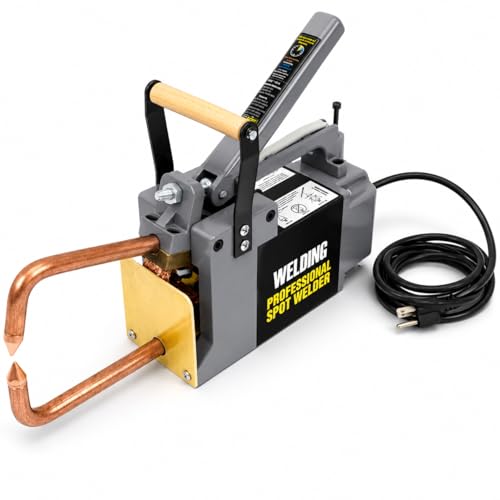
Stark USA 110V Portable Spot Welder
Best for: light sheet metal repair
- Input Voltage
- 110V
- Features
- Spot Welding
- Application
- Sheet Metal
- Dimensions
- 20 × 5 × 9 inches
View on Amazon: Stark USA 110V Portable Spot Welder Affiliate link
This Stark USA unit is a 110V handheld spot welder designed for sheet metal work. It delivers a maximum output current of 5500A from a 1.5KVA input capacity. The device features copper welding tips and weighs under 10 pounds based on its compact dimensions of 5 by 9 by 20 inches. It suits users needing portable equipment for automotive or electronics assembly tasks.
Pros
- 110V single-phase input for standard outlets
- 5500A maximum output current for efficient welding
- Copper welding tips for durable performance
- Compact handheld design with attached handle
Cons
- Limited to 110V input voltage
- No adjustable current settings listed
- Fixed 1/8" welding tip size
Good fit if
- You need a lightweight tool for mobile repair jobs
- You work with standard 110V household power
- You weld thin sheet metal regularly
Skip if
- You require high-amperage welding for thick steel
- You only have access to 220V power sources
- You need precise current control for delicate work
Verdict: Stark USA 110V Portable Spot Welder fits hobbyists and mobile technicians who prioritize portability over raw power. It handles light sheet metal tasks well but lacks the capacity for heavy industrial use.

Stark USA 220V Portable Spot Welder
Best for: 220V sheet metal fabrication
- Input Voltage
- 220V
- Material
- Steel
- Features
- Spot Welding
- Application
- Sheet Metal
- Weight
- 28.9 pounds
View on Amazon: Stark USA 220V Portable Spot Welder Affiliate link
This Stark USA handheld unit operates on 220V input and delivers a maximum output current of 6750A. It weighs 28.9 pounds and features copper welding tips for durable performance. The device includes extra tips for replacement. It suits users needing high power for sheet metal fabrication, automotive work, or electronics assembly. The compact design allows for transport via the attached handle.
Pros
- 220V input voltage for high power
- 6750A maximum output current
- Durable copper welding tips
- Includes extra replacement tips
- Lightweight and compact design
Cons
- Requires 220V power outlet
- Weighs 28.9 pounds
- No included carrying case mentioned
Good fit if
- You have access to a 220V outlet
- You need high amperage for thicker metals
- You work on sheet metal fabrication projects
Skip if
- You only have standard 110V outlets
- You prefer a lighter tool under 20 pounds
- You need a unit with a carrying case
Verdict: Stark USA 220V Portable Spot Welder is a powerful option for users with 220V power access who need high amperage for heavy-duty sheet metal tasks. Its copper tips and included extras make it suitable for frequent fabrication work.
Specifications side by side
| Spec | Stark USA 110V Portable Spot Welder | Stark USA 220V Portable Spot Welder |
|---|---|---|
| Input Voltage | 110V | 220V |
| Material | not stated | Steel |
| Features | Spot Welding | Spot Welding |
| Application | Sheet Metal | Sheet Metal |
| Dimensions | 20 × 5 × 9 inches | not stated |
| Weight | not stated | 28.9 pounds |
| Size | 110V | not stated |
| Model | 55009 | 55010 |
Frequently asked questions
Can the 110V Stark USA spot welder handle thick steel?
No. The 110V model is designed for light sheet metal repair. It lacks the capacity for heavy industrial use or thick steel tasks. You should choose the 220V unit if you need to weld heavier gauge materials. The 110V version prioritizes portability over raw power output.
What is the weight difference between the two models?
The 220V model weighs 28.9 pounds. The 110V model does not list a weight in its specifications. However, the 110V unit has a compact footprint of 5 by 9 by 20 inches. This makes it easier to maneuver for mobile technicians who need a smaller tool.
Do both welders use copper tips?
Yes. Both units utilize copper tips for spot welding. The 220V model includes extra accessories alongside these tips. The 110V model also focuses on spot welding applications. Copper tips help dissipate heat efficiently during the welding process on sheet metal.
Which model is better for hobbyists?
The 110V model fits hobbyists best. It prioritizes portability over raw power. You can use it for light sheet metal tasks without needing specialized electrical infrastructure. The 220V unit is better for frequent fabrication work due to its higher power requirements and weight.
What is the model number for the 220V unit?
The model number is 55010. This unit requires a 220V input. It is made of steel and is intended for sheet metal fabrication. The 110V counterpart carries the model number 55009. Check the label on the device to confirm your specific unit.
Is the 220V welder suitable for home use?
It depends on your electrical setup. The 220V model requires a 220V input, which is not standard in many homes. You need access to this specific voltage for it to work. If you only have standard outlets, the 110V model is the practical choice.