VEVOR 250A Dual-Voltage Multi-Process Welder or VEVOR 50A Dual-Voltage Pilot Arc? Which VEVOR Model to Buy
As an Amazon Associate we earn from qualifying purchases. Links on this page are affiliate links.
When you compare the vevor 250a dual voltage multi process welder vs 50a dual voltage pilot, you are looking at two distinct tools. Both units feature dual voltage input and digital displays for clear monitoring. The main difference lies in their function. One is a multi-process welder for joining metals. The other is a plasma cutter for slicing through steel. You need to decide which task fits your workshop needs.
Key differences
| Aspect | VEVOR 250A Dual-Voltage Multi-Process Welder | VEVOR 50A Dual-Voltage Pilot Arc Plasma Cutter |
|---|---|---|
| Welding/Cutting Process | MIG, TIG, Stick, Flux Core | Plasma Cutting |
| Amperage | 250A | 50A |
| Max Cutting/Welding Thickness | Up to 15mm | Up to 16mm (at 220V) |
| Key Features | Pulse, Synergic Control | Non-Touch Pilot Arc, IGBT Inverter |
Which one should you choose?
Choose VEVOR 250A Dual-Voltage Multi-Process Welder if
- You need to weld steel, aluminum, or stainless steel using MIG, TIG, or Stick methods.
- You require high amperage for thick materials up to 15mm.
- You want synergic control to automate wire feed and voltage settings.
Choose VEVOR 50A Dual-Voltage Pilot Arc Plasma Cutter if
- Your primary goal is cutting through metal sheets or plates.
- You need to cut rusty or rough surfaces without direct contact.
- You want a dedicated tool for precise plasma cutting tasks.
Verdict: Choose the 250A model if you need to join metals using various welding processes. Choose the 50A pilot arc unit if you only need to cut metal. They serve different purposes, so pick the tool that matches your main task.
Welder vs Plasma Cutter Specs
Welding Process
The VEVOR 250A Dual-Voltage Multi-Process Welder is a versatile machine supporting five distinct welding methods. You can use MIG Pulse, gas MIG, gasless MIG, MMA (Stick), and Lift TIG. This flexibility allows you to join various metals using different techniques without switching tools. In contrast, the VEVOR 50A Dual-Voltage Pilot Arc is a dedicated plasma cutter. It does not perform welding tasks. It is designed solely for cutting metal using a high-velocity jet of ionized gas. If you need to join materials, the 250A model is the only choice. If you only need to cut, the plasma cutter is specialized for that single task.
Amperage
Amperage determines the power and thickness capacity of the tool. The VEVOR 250A Dual-Voltage Multi-Process Welder delivers a maximum output current of 250A. This high amperage supports welding thicknesses up to 15mm, making it suitable for heavy-duty fabrication and thick steel plates. The VEVOR 50A Dual-Voltage Pilot Arc offers a maximum output current of 50A. While this is sufficient for cutting metal, it is significantly lower than the welder. The 250A unit provides more raw power for fusion, while the 50A unit provides controlled power for separation. The welder has the higher amperage rating by a wide margin.
Input Voltage
Both units support dual voltage input, which is a key feature for versatility in different work environments. The VEVOR 250A Dual-Voltage Multi-Process Welder operates on both 110V and 220V. This allows you to use it in standard home outlets or higher-power industrial sockets. Similarly, the VEVOR 50A Dual-Voltage Pilot Arc also supports 110V and 220V input. This shared specification means both tools can adapt to your available power source. You do not need to choose one based on voltage compatibility. Both models offer the same flexibility in electrical connection, resulting in a tie for this aspect.
Cutting Capacity
The VEVOR 50A Dual-Voltage Pilot Arc excels at cutting metal thickness. It achieves clean cuts up to 3/10 inch (10mm) at 110V and 1/2 inch (12mm) at 220V. The maximum cutting thickness reaches 5/8 inch (16mm) when running on 220V. The VEVOR 250A Dual-Voltage Multi-Process Welder is not designed for cutting. While it can weld up to 15mm thickness, it cannot slice through material. If your primary task involves cutting steel, stainless steel, or aluminum, the plasma cutter is the superior tool. The welder cannot perform this function at all, giving the plasma cutter a clear advantage here.
Material Compatibility
Material compatibility differs based on the tool's function. The VEVOR 250A Dual-Voltage Multi-Process Welder handles mild steel, aluminum, stainless steel, cast iron, and sheet metal. It also works with square pipes and metal cages. It accepts flux core wire, gas solid wire, and aluminum wire. The VEVOR 50A Dual-Voltage Pilot Arc cuts carbon steel, stainless steel, aluminum, and mesh metal. Both tools work with aluminum and steel. However, the welder can also handle cast iron, which the plasma cutter data does not mention. The welder offers slightly broader material versatility for joining, while the plasma cutter is limited to cutting conductive metals.
Control Features
Both machines feature intelligent control systems and digital displays. The VEVOR 250A Dual-Voltage Multi-Process Welder uses synergic control to automatically adjust current and wire feed speed based on wire thickness. It offers 2T and 4T modes for precise trigger control. The VEVOR 50A Dual-Voltage Pilot Arc also includes 2T/4T functions and features adjustable PT time (1-6s) and PA time (0.1-3s) to extend consumable life. Both have overheat and overload protection. The welder adds pulse welding for better thermal control. The plasma cutter adds non-touch pilot arc for cutting rough surfaces. Both offer advanced control, but for different processes.
Build and Size
Physical dimensions and weight affect portability and workspace fit. The VEVOR 250A Dual-Voltage Multi-Process Welder measures 16.9 x 7.1 x 12.6 inches and weighs 17.4 pounds. It is black and orange. The VEVOR 50A Dual-Voltage Pilot Arc measures 14.4 x 7.5 x 11.4 inches and weighs 19.4 pounds. It comes in silver, black, and orange. The welder is longer and lighter, while the plasma cutter is shorter, wider, and heavier. The plasma cutter is more compact in length, which may help in tight spaces. The welder is lighter to carry. Both are robust industrial units with different footprint characteristics.
Which VEVOR Welder Fits Your Needs
Welders needing multi-process versatility
You need a single machine for MIG, Stick, and Lift TIG. This 250A unit supports five welding processes and handles up to 15mm thickness. The synergic control adjusts current and wire feed automatically. It works with flux core and solid wire, making it ideal for diverse fabrication tasks.
Users cutting rusty or rough metal
You require clean cuts on uneven surfaces. This 50A plasma cutter features a non-touch pilot arc that ignites without contacting the metal. It cuts up to 16mm at 220V. The adjustable PT and PA times extend consumable life. It is designed for stable output on carbon steel and aluminum.
Fabricators working with aluminum and steel
You join various metals including aluminum and stainless steel. This welder supports 0.04 to 0.05 inch aluminum wire and 0.03 to 0.04 inch solid wire. The pulse function reduces spatter and improves thermal control. It delivers 250A output for thick materials up to 15mm with smooth, flawless results.
The products compared

VEVOR 250A Dual-Voltage Multi-Process Welder
Best for: Heavy-duty multi-process welding and aluminum work
- Welding Process
- TIG, Stick, MIG, Flux Core
- Amperage
- 250A
- Input Voltage
- Dual Voltage
- Material
- Aluminum
- Features
- Pulse, Synergic Control, IGBT Inverter, Digital Display
- Dimensions
- 7.09 × 7.09 × 12.6 inches
View on Amazon: VEVOR 250A Dual-Voltage Multi-Process Welder Affiliate link
This VEVOR unit delivers 250A output across five welding processes, including pulse MIG, gas MIG, flux core, MMA, and lift TIG. It handles dual voltage input for flexible power use and features synergic control to automate settings. The machine supports aluminum welding with a 15mm thickness capacity. It includes an HD LCD screen for clear monitoring. This model suits users needing high amperage and multi-process versatility in a single package.
Pros
- 250A maximum output current for thick materials
- 5-in-1 capability: MIG, Pulse MIG, Flux Core, MMA, Lift TIG
- Dual voltage support (110V/220V) for versatile power sources
- Synergic control automatically adjusts current and wire feed speed
- HD LCD screen with overheat and overload protection
Cons
- Aluminum welding torch is sold separately
- Lift TIG torch is sold separately
- Heavier build at 17.4 pounds compared to lighter 50A units
Good fit if
- You need to weld aluminum and stainless steel
- You require high amperage for thick materials up to 15mm
- You want synergic control to simplify complex welding settings
Skip if
- You primarily perform light-duty cutting tasks
- You need a compact unit under 10 pounds
- You want a complete kit with all torches included
Verdict: VEVOR 250A Dual-Voltage MIG Welder fits professionals needing high amperage and multi-process versatility. It suits users who weld aluminum or thick steel and value automated synergic settings over portability.
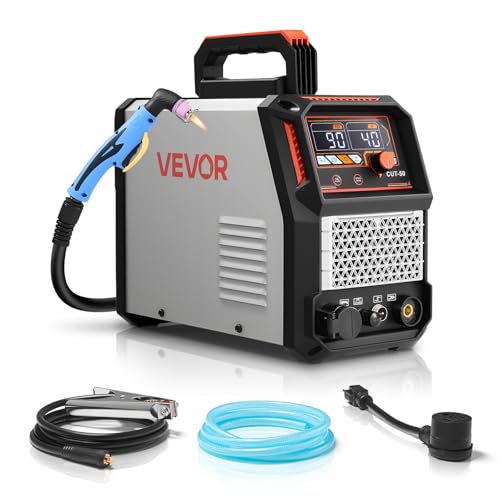
VEVOR 50A Dual-Voltage Pilot Arc Plasma Cutter
Best for: cutting rusty steel up to 5/8 inch
- Input Voltage
- Dual Voltage
- Features
- IGBT Inverter, Plasma Cutter, Digital Display
- Dimensions
- 14.5 × 7.48 × 11.4 inches
- Weight
- 19.4 pounds
View on Amazon: VEVOR 50A Dual-Voltage Pilot Arc Plasma Cutter Affiliate link
This VEVOR plasma cutter uses a 50A output to cut metal up to 1/2 inch at 110V and 5/8 inch at 220V. The non-touch pilot arc handles rusty surfaces without direct contact. A digital display shows real-time settings, while adjustable PT and PA times help extend consumable life. It weighs 19.4 pounds and measures 14.5 inches long. You get stable cuts on steel and aluminum with built-in overload protection.
Pros
- Cuts 1/2 inch metal at 110V and 5/8 inch at 220V
- Non-touch pilot arc works on rough or rusty surfaces
- Digital display provides clear interface and real-time monitoring
- Adjustable PT and PA times extend consumable lifespan
Cons
- 50A output is lower than the 250A multi-process welder
- Designed for cutting only, not welding processes
- 19.4 pounds weight is heavier than lighter handheld units
Good fit if
- You need to cut steel up to 5/8 inch thick
- You work with rusty or painted metal surfaces
- You want a dual-voltage machine for garage use
Skip if
- You need to perform welding operations
- You require cutting thicker than 5/8 inch steel
- You prefer a lightweight unit under 15 pounds
Verdict: VEVOR 50A Dual-Voltage Plasma Cutter is a focused tool for users who need to cut medium-thickness metal on rusty surfaces. It fits garage workshops where dual-voltage flexibility and precise consumable control matter more than welding versatility.
Specifications side by side
| Spec | VEVOR 250A Dual-Voltage Multi-Process Welder | VEVOR 50A Dual-Voltage Pilot Arc Plasma Cutter |
|---|---|---|
| Welding Process | TIG, Stick, MIG, Flux Core | not stated |
| Amperage | 250A | not stated |
| Input Voltage | Dual Voltage | Dual Voltage |
| Material | Aluminum | not stated |
| Features | Pulse, Synergic Control, IGBT Inverter, Digital Display | IGBT Inverter, Plasma Cutter, Digital Display |
| Dimensions | 7.09 × 7.09 × 12.6 inches | 14.5 × 7.48 × 11.4 inches |
| Weight | 17.4 pounds | 19.4 pounds |
| Size | 16.9 x 7.1 x 12.6 in | 14.4 x 7.5 x 11.4 in |
| Color | Black + Orange | Silver, Black, Orange |
| Model | MIG-250 | CUT-50 |
Frequently asked questions
Is the VEVOR 250A welder suitable for cutting metal?
No, the VEVOR 250A Dual-Voltage Multi-Process Welder is designed for joining materials, not cutting them. It supports MIG, Stick, and Lift TIG processes to create strong bonds. If you need to slice through rusty steel or thin sheets, you should look at the VEVOR 50A Pilot Arc Plasma Cutter instead. That unit is built specifically for cutting applications with precise control.
Can the VEVOR 50A weld aluminum?
No, the VEVOR 50A Dual-Voltage Pilot Arc Plasma Cutter is not a welding machine. It is a cutting tool designed to slice through metal, including rusty steel up to 5/8 inch thick. It does not have welding processes like MIG or TIG. To weld aluminum, you need the VEVOR 250A Multi-Process Welder, which handles aluminum joining with its multi-process capabilities.
Which machine is better for thick steel projects?
The VEVOR 250A Dual-Voltage Multi-Process Welder is the better choice for thick steel. It delivers 250A of power and supports five welding methods, including MIG and Stick. This high amperage allows you to join heavy gauge materials effectively. The 50A Plasma Cutter is intended for cutting medium-thickness metal, not for welding thick structural steel pieces together in a fabrication setting.
Does the VEVOR 250A have synergic control?
Yes, the VEVOR 250A Dual-Voltage Multi-Process Welder includes synergic control features. This technology automatically adjusts current and wire feed settings to simplify the welding process for you. It helps maintain consistent weld quality, especially when working with different metals like aluminum. This feature is not listed for the 50A Plasma Cutter, which focuses on cutting precision rather than welding automation.
Is the VEVOR 50A unit portable for garage use?
Yes, the VEVOR 50A Dual-Voltage Pilot Arc Plasma Cutter is compact for garage workshops. It measures 14.5 inches in length and weighs 19.4 pounds. Its dual-voltage input allows flexible power connections in various settings. While portable, it is a dedicated cutting tool. If you need a welding machine, the 250A model is also portable at 17.4 pounds but offers welding versatility instead.
Can I use both machines on a single circuit?
Both units feature dual-voltage input, which provides flexibility for different power sources. This means you can often operate them on various standard outlets depending on your region. However, the 250A Welder draws significantly more power due to its 250A output capacity. You must ensure your circuit can handle the load for the welder, while the 50A cutter generally requires less power for cutting operations.