Stark USA 220V Handheld Spot Welder vs Stark USA 110V Portable Spot Welder: Spec Comparison
As an Amazon Associate we earn from qualifying purchases. Links on this page are affiliate links.
Comparing the stark usa 220v handheld spot welder vs 110v portable spot welder helps you pick the right tool for your shop. Both units handle sheet metal fabrication and share the same compact footprint and lever-action design. The main difference lies in their power requirements and output strength. One runs on 220V for higher amperage, while the other uses 110V for broader accessibility. You need to match the voltage to your available power source to ensure efficient welding results.
Key differences
| Aspect | Stark USA 220V Handheld Spot Welder | Stark USA 110V Portable Spot Welder |
|---|---|---|
| Input Voltage | 220V | 110V |
| Maximum Output Current | 6750A | 5500A |
| Rated Input Capacity | 2.5KVA | 1.5KVA |
| Weight | 28.9 pounds | not listed |
| Model Number | 55010 | 55009 |
Which one should you choose?
Choose Stark USA 220V Handheld Spot Welder if
- You have a 220V outlet available in your workspace.
- You need higher amperage for thicker metal sheets.
- You want a unit with a specified weight for transport planning.
Choose Stark USA 110V Portable Spot Welder if
- You only have standard 110V household outlets.
- You are welding lighter gauge materials that require less current.
- You prefer a lower rated input capacity for energy efficiency.
Verdict: Choose the 220V model if you need maximum power for heavier sheet metal and have the correct outlet. The 110V version is better suited for standard home workshops where high-voltage lines are not available. Both tools offer the same compact design and copper tip durability for consistent spot welding.
Specs Comparison: 220V vs 110V Welders
Input Voltage
The Stark USA 220V Handheld Spot Welder requires a 220V electrical outlet, while the Stark USA 110V Portable Spot Welder operates on standard 110V household power. This is the most critical difference for your setup. If your workshop has dedicated high-voltage lines, the 220V model connects directly. If you need to plug into a standard wall socket without modifying your electrical infrastructure, the 110V unit is the practical choice. Both are single-phase electric machines, but the voltage requirement dictates where you can use them. You must ensure your power source matches the tool's specification to avoid damage or failure to operate.
Maximum Output Current
Power output differs significantly between these two units. The Stark USA 220V Handheld Spot Welder delivers a maximum output current of 6750A. In contrast, the Stark USA 110V Portable Spot Welder provides a maximum of 5500A. Higher amperage generally allows for faster welding cycles and the ability to join thicker metals more effectively. The 220V model offers roughly 22% more current, which can reduce weld time and improve consistency on denser materials. If you frequently work with heavier gauge sheet metal, the higher amperage of the 220V version provides a tangible performance advantage in speed and penetration.
Rated Input Capacity
The electrical load each machine places on your circuit varies. The Stark USA 220V Handheld Spot Welder has a rated input capacity of 2.5KVA. The Stark USA 110V Portable Spot Welder is rated at 1.5KVA. The lower KVA rating of the 110V model means it draws less power from the grid, making it easier to run on standard residential circuits without tripping breakers. The 220V unit demands more energy, requiring a circuit capable of handling the higher load. For users with limited electrical capacity or those working in areas with unstable power, the lower input requirement of the 110V version is a practical benefit.
Weight
Portability is influenced by the weight of the handheld unit. The Stark USA 220V Handheld Spot Welder weighs 28.9 pounds. The weight for the Stark USA 110V Portable Spot Welder is not listed in the provided specifications, so a direct comparison is not possible based on available data. Both tools feature an attached handle for transport, but the 220V model's specific weight is known. If you need to carry the welder frequently to different job sites, the known weight of the 220V unit helps you plan for physical strain. Without the 110V weight, you cannot determine which is lighter to carry.
Dimensions
Both spot welders share identical physical dimensions. The Stark USA 220V Handheld Spot Welder measures 5 inches in width, 9 inches in height, and 20 inches in length. The Stark USA 110V Portable Spot Welder has the same width, height, and length. This consistency means they occupy the same amount of space in your workshop or vehicle. The compact footprint allows for easy storage and maneuverability around workpieces. Since the size is identical, your choice will not be influenced by spatial constraints or portability needs related to the tool's physical bulk. Both fit similarly into tight spaces.
Which spot welder fits your needs
Users with standard home outlets
This 110V model plugs into standard household circuits, so you do not need to install special wiring. It delivers 1.5KVA input capacity and 5500A output current. This power level handles sheet metal work for automotive repairs and electronics assembly without requiring a dedicated industrial line.
Heavy duty fabrication tasks
The 220V unit provides higher power with 2.5KVA input and 6750A output current. This extra capacity ensures swift welding for heavier metal thicknesses. You get reliable performance for light industrial tasks and auto body work. The copper tips maintain durability under higher stress conditions.
Portable workshop mobility
Weighing 28.9 pounds, this 220V welder is compact enough to transport. Its dimensions are 5 by 9 by 20 inches. The attached handle allows you to move it between job sites easily. You get a robust build with steel construction that withstands regular travel.
The products compared

Stark USA 220V Handheld Spot Welder
Best for: 220V users welding thick sheet metal
- Input Voltage
- 220V
- Material
- Steel
- Features
- Spot Welding
- Application
- Sheet Metal
- Dimensions
- 20 × 5 × 9 inches
- Weight
- 28.9 pounds
View on Amazon: Stark USA 220V Handheld Spot Welder Affiliate link
This 220V handheld spot welder delivers a maximum output current of 6750A with a 2.5KVA rated input capacity. It handles sheet metal up to 1/8" thick using durable copper tips. The unit measures 20 inches long and weighs 28.9 pounds. You get extra tips for replacement. This machine suits users with 220V power access who need high-amperage performance for automotive or fabrication tasks.
Pros
- High maximum output current of 6750A
- Handles sheet metal up to 1/8" thick
- Includes extra copper welding tips
- Lightweight and compact design for transport
Cons
- Requires 220V electrical outlet
- Heavy at 28.9 pounds
- Long 20-inch length may limit tight access
Good fit if
- You have 220V power available at your workspace
- You need high current for thicker sheet metal
- You work on automotive or fabrication projects
Skip if
- You only have standard 110V household outlets
- You need a very lightweight tool under 20 pounds
- You require a compact unit shorter than 15 inches
Verdict: Stark USA 220V Handheld Spot Welder fits professionals who need high-amperage output for thick sheet metal and have the necessary 220V power supply.
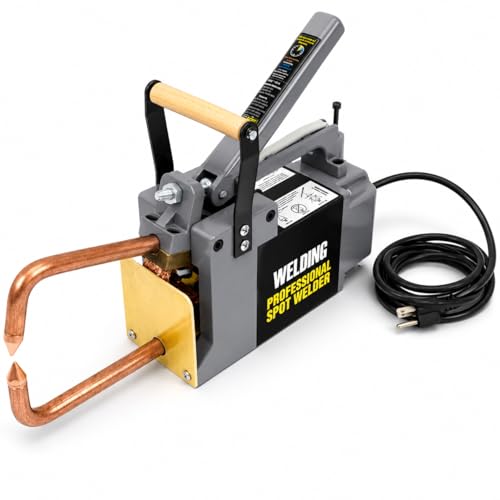
Stark USA 110V Portable Spot Welder
Best for: Light sheet metal work on 110V circuits
- Input Voltage
- 110V
- Features
- Spot Welding
- Application
- Sheet Metal
- Dimensions
- 20 × 5 × 9 inches
View on Amazon: Stark USA 110V Portable Spot Welder Affiliate link
This 110V handheld spot welder is designed for sheet metal work in light industrial or home settings. It features a 1.5KVA input capacity and delivers up to 5500A of output current for efficient welding. The unit measures 20 inches in length and includes durable copper tips. Its compact design allows for easy transport to different job sites. You can operate it by pulling the lever and applying pressure.
Pros
- 110V single-phase power input for standard outlets
- 5500A maximum output current for swift welding
- Durable copper welding tips for reliable performance
- Compact dimensions of 5x9x20 inches
Cons
- Lower 110V input limits power compared to 220V models
- No digital display to monitor real-time settings
- Manual lever operation requires physical pressure
Good fit if
- You need a welder that plugs into standard 110V outlets
- You work on light to medium-duty sheet metal tasks
- You require a portable unit for transport between sites
Skip if
- You need high-amperage welding for thick materials
- You require 220V power for maximum output
- You prefer automated digital controls over manual levers
Verdict: Stark USA 110V Portable Spot Welder suits hobbyists and light fabricators who need accessible power. It offers sufficient current for thin sheet metal but lacks the raw power of higher-voltage alternatives.
Specifications side by side
| Spec | Stark USA 220V Handheld Spot Welder | Stark USA 110V Portable Spot Welder |
|---|---|---|
| Input Voltage | 220V | 110V |
| Material | Steel | not stated |
| Features | Spot Welding | Spot Welding |
| Application | Sheet Metal | Sheet Metal |
| Dimensions | 20 × 5 × 9 inches | 20 × 5 × 9 inches |
| Weight | 28.9 pounds | not stated |
| Size | 220V | 110V |
| Model | 55010 | 55009 |
Frequently asked questions
Can the Stark USA 220V welder handle thicker materials?
Yes, this model is designed for thick sheet metal. It delivers high-amperage output suitable for professional-grade fabrication tasks. The 220V input provides the necessary power density to penetrate heavier gauges that standard household circuits cannot support effectively.
Is the 110V model suitable for home garage use?
It is ideal for hobbyists and light fabricators. The 110V Portable Spot Welder plugs into standard household outlets, eliminating the need for specialized wiring. It offers sufficient current for thin sheet metal work in a typical residential setting.
Do both welders share the same physical dimensions?
Both units measure 5 inches in width, 9 inches in height, and 20 inches in length. This shared compact footprint allows for consistent storage and handling. The 220V model weighs 28.9 pounds due to its steel construction and internal components.
What is the primary difference in electrical requirements?
The 220V Handheld Spot Welder requires a dedicated 220V electrical outlet. In contrast, the 110V Portable Spot Welder operates on standard 110V household power. This distinction dictates where and how you can install and operate each machine.
Which model is better for professional sheet metal work?
The 220V Handheld Spot Welder fits professionals needing high-amperage output. Its design targets thick sheet metal applications. The 110V version lacks the raw power required for heavy-duty industrial tasks, making it less suitable for professional fabrication environments.
Are both tools made from steel?
Yes, the 220V Handheld Spot Welder is constructed from steel. This material choice contributes to its durability and weight. The 110V model shares the same application focus on sheet metal, ensuring consistent performance for its intended light-duty tasks.
Can I use the 220V welder on a standard outlet?
No, it requires a 220V power supply. You cannot plug it into a standard 110V household circuit. Ensure your workspace has the correct electrical infrastructure before attempting to use the higher-voltage model for your welding projects.