Amperage in Welders: What It Is and Is It Worth It?
As an Amazon Associate we earn from qualifying purchases. Links on this page are affiliate links.
Amperage Explained for Welders
Amperage is the flow of electrical current through your welder. It determines how much heat the arc generates. Higher amperage means more heat. This heat melts the base metal and filler material faster. You need enough current to fuse thick plates together. If the amperage is too low, the arc will struggle to penetrate the joint. The weld will lack strength and may fail under stress.
Welders in this niche offer a range of outputs. You will see models rated at 140A, 160A, 200A, 205A, 225A, and 250A. These numbers represent the maximum current the machine can deliver. A 140A unit is suitable for light repairs and thin sheet metal. It handles small tasks without burning through the material. A 160A welder offers a bit more power for slightly thicker stock.
As you move up, the 200A and 205A models provide solid performance for general fabrication. They handle medium thicknesses with ease. The 225A and 250A units are built for heavy duty work. They melt thick steel quickly. These high output machines are essential for structural work or heavy equipment repair.
Understanding amperage explained helps you pick the right tool. You must match the spec to your material thickness. Thicker metal requires higher current to achieve full penetration. If you buy a machine with insufficient amperage, you will spend more time trying to make a weak weld. Conversely, a machine with excessive amperage for thin metal can burn holes easily. Check the maximum output listed on the product page. Ensure it meets your heaviest expected task. This spec is the primary indicator of a welder’s capability. Choose wisely based on your project needs.
Amperage Levels Compared
140A
Welders with 140A amperage provide lower heat input. This range suits thin sheet metals and light DIY tasks. You get better control over delicate materials without burning through. The trade-off is limited capacity for thick steel or heavy structural work. This setting is practical for hobbyists who prioritize ease of use and portability over raw power. It allows for cleaner welds on small projects. You avoid the risk of warping thin gauge metals. This level is not suitable for industrial fabrication or thick plate welding. It remains a focused choice for specific, lighter applications.
160A
At 160A, welders handle light fabrication and general maintenance. This amperage balances power and control for most home workshops. You can weld medium-thickness steel with reasonable speed. The YESWELDER 160A Dual-Voltage Multi-Process Welder exemplifies this tier. It supports multiple processes like MIG, TIG, and Stick. This versatility makes it a solid choice for varied tasks. However, it lacks the raw force needed for heavy-duty industrial jobs. You might struggle with thick structural beams. It is ideal for users who need a portable unit for occasional repairs. It offers a practical middle ground for non-professional users.
200A
200A welders offer substantial power for mixed-material projects. You can tackle thicker metals and perform more aggressive welding. The ARCCAPTAIN 200A Dual-Voltage Multi-Process Welder fits this category well. It provides clear digital feedback for precise control. This amperage is versatile for farm maintenance and general fabrication. You gain the ability to run larger electrodes and weld faster. The trade-off is increased weight and power consumption. You need a stable power source to maintain consistent arcs. This level is not ideal for very thin metals due to heat input. It serves as a robust option for serious hobbyists and light professionals.
205A
With 205A, welders deliver high amperage for aluminum and MIG welding. This specific output supports digital control and specialized material handling. The ARCCAPTAIN 205A Dual-Voltage MIG Welder highlights this capability. You benefit from precise settings for aluminum projects. This amperage bridges the gap between standard 200A units and higher power models. It offers enough heat for thicker aluminum sections. The trade-off is a focus on specific processes rather than universal versatility. You may not find the same multi-process flexibility as lower amperage units. It is best for users who prioritize digital precision and aluminum welding capabilities. It remains a lightweight option for its power class.
225A
225A welders are designed for precise AC TIG welding. This amperage supports aluminum TIG work with foot control. The PRIMEWELD 225 Amp AC/DC TIG and Stick Welder is a prime example. You get precise arc stability for thin aluminum. This level is not suitable for MIG welding or easy transport due to size. The trade-off is a focus on specific high-quality welds over general utility. You sacrifice portability for arc control and stability. It fits fabricators who need precise AC TIG performance. You avoid the risk of tungsten contamination in aluminum welding. This is a specialized choice for high-quality aluminum fabrication tasks.
250A
At 250A, welders provide maximum power for heavy-duty fabrication. You can cut through thick metals with ease. The YESWELDER 250A Dual-Voltage Multi-Process Welder exemplifies this high-power tier. This amperage is unsuitable for delicate thin-metal work due to high heat input. You gain speed and penetration for structural steel. The trade-off is significant weight and power requirements. You need a robust power supply to sustain this output. It is ideal for professionals requiring maximum capability. You avoid the limitations of lower amperage units on thick plates. This level is not for hobbyists seeking portability or thin metal precision.
Is High Amperage Worth It
Who needs it
You need high amperage if you regularly weld thick steel plates or structural components. Models offering 200A to 250A deliver the necessary heat to penetrate deep into the metal. This capability is essential for fabrication shops and industrial projects. If you work with materials over half an inch thick, lower amperage settings will struggle to create a strong fusion. You will find yourself needing multiple passes or preheating the metal, which slows down your workflow. The 225A and 250A options provide a safety margin for demanding tasks. They ensure consistent arc stability even when welding in challenging positions. For professionals who prioritize speed and joint strength, these higher current ratings are not just convenient; they are critical for meeting project specifications and ensuring structural integrity in heavy-duty applications.
Who can skip it
You can ignore high amperage if you mostly work with thin sheet metals or perform light DIY repairs. Welders with 140A to 160A amperage offer better control for delicate materials. High current can burn through thin steel quickly, leading to warping or holes. If your projects involve automotive bodywork or small metal crafts, excessive heat is a liability. You should prioritize precision and ease of use over raw power. Lower amperage settings allow for finer adjustments and smoother beads on lightweight metals. Focusing on features like duty cycle and portability may serve you better than chasing high current numbers. These specs matter more for versatility in home workshops where thin materials dominate your daily tasks.
Welder Amperage Glossary
Amperage
The electrical current flowing through the welder. It controls the heat output and determines how quickly the metal melts during the welding process.
Welding Process
The specific method used to join metals, such as MIG, TIG, or Stick welding. Each process requires different amperage ranges for optimal results.
Input Voltage
The electrical power required to run the machine, typically 120V or 240V. Higher voltage allows for greater amperage output in industrial settings.
Material Thickness
The depth of the metal being welded. Thicker materials require higher amperage to ensure proper penetration and a strong, durable bond.
Current Type
Whether the welder uses alternating current (AC) or direct current (DC). DC offers more stable arcs, while AC is often used for aluminum.
Application
The intended use for the welder, such as automotive repair or structural fabrication. Your application dictates the necessary amperage and feature set.
Wattage
The total power consumption of the welder, calculated by multiplying voltage and amperage. It helps determine the circuit capacity needed for safe operation.
Quick picks
| # | Product | Best for | Price |
|---|---|---|---|
| 1 | ARCCAPTAIN 200A Dual-Voltage Multi-Process Welder | Mixed-material DIY and farm maintenance | Check price of ARCCAPTAIN 200A Dual-Voltage Multi-Process Welder on Amazon |
| 2 | YESWELDER 250A Dual-Voltage Multi-Process Welder | Heavy-duty fabrication and thick metals | Check price of YESWELDER 250A Dual-Voltage Multi-Process Welder on Amazon |
| 3 | PRIMEWELD 225 Amp AC/DC TIG and Stick Welder | Aluminum TIG welding with foot control | Check price of PRIMEWELD 225 Amp AC/DC TIG and Stick Welder on Amazon |
| 4 | BESTMIG 200A Dual-Voltage Multi-Process Welder | versatile multi-process welding with digital control | Check price of BESTMIG 200A Dual-Voltage Multi-Process Welder on Amazon |
| 5 | ARCCAPTAIN 205A Dual-Voltage MIG Welder | Digital control and aluminum welding | Check price of ARCCAPTAIN 205A Dual-Voltage MIG Welder on Amazon |
| 6 | YESWELDER 160A Dual-Voltage Multi-Process Welder | Light fabrication and DIY projects | Check price of YESWELDER 160A Dual-Voltage Multi-Process Welder on Amazon |
Our 6 picks

ARCCAPTAIN 200A Dual-Voltage Multi-Process Welder
Best for: Mixed-material DIY and farm maintenance
- Amperage
- 200A (what this guide is about)
- Welding Process
- TIG, Stick, MIG, Flux Core
- Input Voltage
- 220V
- Material
- Aluminum
- Features
- Spool Gun, Spot Welding
- Dimensions
- 3.54 × 2.36 × 2.76 inches
View on Amazon: ARCCAPTAIN 200A Dual-Voltage Multi-Process Welder Affiliate link
This ARCCAPTAIN MIG200 delivers 200A of amperage across six welding processes, including MIG, Stick, and Lift TIG. It supports dual voltage input and features a large LED display for clear readouts without removing your helmet. The unit includes a shoulder strap and handle for portability. Its synergic control automatically matches current to wire diameter, simplifying setup for various materials like aluminum and steel.
Pros
- 200A amperage output for versatile metal thicknesses
- 6-in-1 multi-process capability including Lift TIG and Flux Core
- Large LED display readable without removing safety gear
- Synergic MIG control for automated parameter matching
- Dual voltage support for 110V and 220V inputs
Cons
- Spool gun and TIG gun are not included
- Separate rollers required for .023" and .040" wires
- Limited to 10 preset settings per welding mode
Good fit if
- You need a single machine for MIG, Stick, and TIG tasks
- You value clear digital readouts during welding
- You work with both aluminum and steel materials
Skip if
- You require included spool gun or TIG torch accessories
- You prefer analog dials over digital displays
- You need more than 10 preset memory slots
Verdict: ARCCAPTAIN MIG200 200A Multi-Process Welder fits users who want a portable, multi-process unit with clear digital feedback for mixed-material projects. It is not ideal for those who need all accessories included or extensive preset memory.
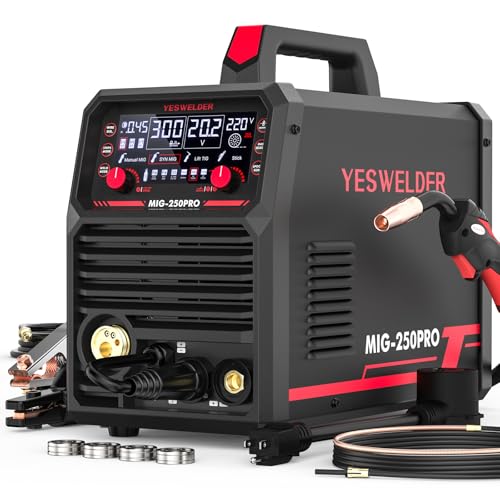
YESWELDER 250A Dual-Voltage Multi-Process Welder
Best for: Heavy-duty fabrication and thick metals
- Amperage
- 250A (what this guide is about)
- Welding Process
- TIG, Stick, MIG, Flux Core
- Input Voltage
- Dual Voltage
- Material
- Aluminum
- Features
- Pulse, Spool Gun, Digital Display
View on Amazon: YESWELDER 250A Dual-Voltage Multi-Process Welder Affiliate link
This YESWELDER unit delivers 250A of output power, making it the highest-amperage option in this guide. It supports dual voltage input for flexibility across different power sources. The machine offers six welding processes, including MIG, flux core, and lift TIG. A digital display helps you monitor settings clearly. Synergic MIG mode adjusts voltage automatically based on wire speed. This setup suits heavy fabrication work where high amperage is necessary.
Pros
- 250A maximum amperage output
- Dual voltage 110V/220V input
- 6-in-1 welding process support
- Digital display for clear monitoring
- Synergic MIG auto-voltage adjustment
Cons
- Highest amperage in the list limits portability
- Lift TIG torch sold separately
- Spool gun sold separately
Good fit if
- You need high amperage for thick metals
- You work with both 110V and 220V outlets
- You want synergic MIG for easier setup
Skip if
- You prefer the lowest amperage for thin sheet metal
- You need a compact unit for tight spaces
- You want all accessories included in the box
Verdict: YESWELDER 250A MIG Welder fits professionals who require maximum power for heavy-duty fabrication and appreciate the convenience of dual voltage input. Its high amperage makes it unsuitable for delicate thin-metal work.

PRIMEWELD 225 Amp AC/DC TIG and Stick Welder
Best for: Aluminum TIG welding with foot control
- Amperage
- 225A (what this guide is about)
- Welding Process
- TIG, Stick
- Current Type
- DC
- Features
- Pulse, IGBT Inverter
- Dimensions
- 24 × 19 × 12 inches
- Weight
- 90 pounds
View on Amazon: PRIMEWELD 225 Amp AC/DC TIG and Stick Welder Affiliate link
The PRIMEWELD TIG225X is a 225-amp AC DC TIG and Stick welder. It uses IGBT inverter technology with pulse and AC frequency controls at 200Hz. This setup handles aluminum and stainless steel. It includes a flex torch and foot pedal for heat control. You get dual voltage support for 110V and 220V input. It suits those needing precise arc stability for thinner metals.
Pros
- 225A output for aluminum and stainless steel
- AC DC TIG and Stick processes
- 200Hz pulse and AC frequency control
- Includes flex torch and foot pedal
Cons
- 90-pound weight limits portability
- No MIG welding capability listed
- No digital display mentioned
Good fit if
- You weld aluminum or stainless steel
- You need precise heat control for thin metals
- You use AC TIG processes
Skip if
- You need MIG welding for steel
- You require a lightweight portable unit
- You prefer digital interface controls
Verdict: PRIMEWELD TIG225X 225A AC DC Welder fits fabricators who need precise AC TIG control for aluminum. It is not for those who need MIG welding or easy transport.

BESTMIG 200A Dual-Voltage Multi-Process Welder
Best for: versatile multi-process welding with digital control
- Amperage
- 200A (what this guide is about)
- Welding Process
- TIG, Stick, MIG, Flux Core
- Input Voltage
- Dual Voltage
- Features
- Spool Gun, IGBT Inverter
- Dimensions
- 19.5 × 8 × 14.8 inches
- Weight
- 22 pounds
View on Amazon: BESTMIG 200A Dual-Voltage Multi-Process Welder Affiliate link
The BESTMIG 200A is a 6-in-1 IGBT inverter welder offering gas MIG, flux core, stick, lift TIG, and spot welding. It delivers a real 200A output at a 60% duty cycle on dual 110V/220V input. The unit weighs 22 pounds and features a large LED display for clear data reading. It suits fabricators needing versatile process options and precise digital control for various metal thicknesses.
Pros
- Real 200A output current at 60% duty cycle
- 6-in-1 multi-process capability including lift TIG and spot welding
- Large LED display for clear data visibility
- Dual 110V/220V voltage input
- IGBT inverter technology for precise control
Cons
- Heavier build at 22 pounds compared to lighter 160A models
- 200A amperage is lower than the 250A option on this list
- Requires a spool gun for optimal aluminum welding performance
Good fit if
- You need a single machine for MIG, TIG, and stick welding
- You work with dual voltage power sources
- You prefer digital displays for precise parameter adjustment
Skip if
- You require higher than 200A amperage for thick industrial plates
- You prioritize a lightweight unit under 15 pounds
- You only need basic flux core welding without other processes
Verdict: BESTMIG 200A 6-in-1 Welder fits fabricators who need versatile multi-process capability and precise digital control. It is a solid choice for users who value a rugged build and clear display over maximum amperage.

ARCCAPTAIN 205A Dual-Voltage MIG Welder
Best for: Digital control and aluminum welding
- Amperage
- 205A (what this guide is about)
- Welding Process
- TIG, Stick, MIG, Flux Core
- Input Voltage
- 120V
- Material
- Aluminum
- Features
- Spool Gun, Spot Welding
- Dimensions
- 14.9 × 5.3 × 9.7 inches
View on Amazon: ARCCAPTAIN 205A Dual-Voltage MIG Welder Affiliate link
The ARCCAPTAIN MIG205 Pro offers 205A of amperage for MIG, Stick, and TIG welding. It supports 120V and 240V input and includes a spool gun setup for aluminum. The unit features a large LED display and app control for remote adjustments. At 10 pounds, it is lightweight. This model suits users needing versatile modes and digital convenience.
Pros
- 205A amperage output for varied thicknesses
- 6-in-1 welding modes including Lift TIG
- Large LED display for clear settings
- App control for remote adjustments
- 120V/240V dual voltage input
Cons
- Spool gun and Lift TIG torch sold separately
- Higher amperage than the 140A and 160A options
- Requires extra accessories for full functionality
Good fit if
- You need aluminum welding with a spool gun
- You prefer digital app control for settings
- You want a lightweight unit under 10 pounds
Skip if
- You only need basic MIG welding under 140A
- You want all accessories included in the box
- You prefer analog dials over digital displays
Verdict: The ARCCAPTAIN MIG205 Pro 205A Welder fits users who want digital app control and aluminum welding capabilities. It is ideal for those who need a lightweight, versatile machine with high amperage.

YESWELDER 160A Dual-Voltage Multi-Process Welder
Best for: Light fabrication and DIY projects
- Amperage
- 160A (what this guide is about)
- Welding Process
- TIG, Stick, MIG, Flux Core
- Input Voltage
- Dual Voltage
- Features
- Synergic Control, Digital Display
View on Amazon: YESWELDER 160A Dual-Voltage Multi-Process Welder Affiliate link
The YESWELDER 160A MIG Welder offers 160 amps of output with dual 110V and 220V input options. It supports MIG, flux core, stick, and lift TIG processes. The unit weighs 19.4 pounds and includes an LED display. Synergic control adjusts voltage and wire speed automatically. This compact machine suits beginners and light fabrication tasks where portability matters more than high amperage.
Pros
- 160A output for mild steel work
- Dual 110V/220V voltage compatibility
- 4-in-1 welding process support
- Lightweight 19.4 lb portable design
- Synergic control for beginners
Cons
- Lower 160A amperage limits thick material welding
- TIG function requires separate lift torch purchase
- No digital amperage adjustment shown in data
Good fit if
- You need a lightweight welder for DIY projects
- You work with thin to medium gauge metals
- You want synergic control for easier setup
Skip if
- You regularly weld steel thicker than 1/4 inch
- You require integrated TIG capabilities without extra parts
- You need higher amperage for industrial fabrication
Verdict: YESWELDER 160A MIG Welder fits hobbyists and light fabricators who prioritize portability and ease of use over raw power. It is not suitable for heavy-duty or thick metal welding tasks.
Specifications side by side
| Spec | ARCCAPTAIN 200A Dual-Voltage Multi-Process Welder | YESWELDER 250A Dual-Voltage Multi-Process Welder | PRIMEWELD 225 Amp AC/DC TIG and Stick Welder | BESTMIG 200A Dual-Voltage Multi-Process Welder | ARCCAPTAIN 205A Dual-Voltage MIG Welder | YESWELDER 160A Dual-Voltage Multi-Process Welder |
|---|---|---|---|---|---|---|
| Welding Process | TIG, Stick, MIG, Flux Core | TIG, Stick, MIG, Flux Core | TIG, Stick | TIG, Stick, MIG, Flux Core | TIG, Stick, MIG, Flux Core | TIG, Stick, MIG, Flux Core |
| Amperage | 200A | 250A | 225A | 200A | 205A | 160A |
| Input Voltage | 220V | Dual Voltage | not stated | Dual Voltage | 120V | Dual Voltage |
| Material | Aluminum | Aluminum | not stated | not stated | Aluminum | not stated |
| Current Type | not stated | not stated | DC | not stated | not stated | not stated |
| Features | Spool Gun, Spot Welding | Pulse, Spool Gun, Digital Display | Pulse, IGBT Inverter | Spool Gun, IGBT Inverter | Spool Gun, Spot Welding | Synergic Control, Digital Display |
| Dimensions | 3.54 × 2.36 × 2.76 inches | not stated | 24 × 19 × 12 inches | 19.5 × 8 × 14.8 inches | 14.9 × 5.3 × 9.7 inches | not stated |
| Weight | 14.1 ounces | not stated | 90 pounds | 22 pounds | 10 pounds | not stated |
| Size | 20.9" x 8.5" x 16.1" | MIG-250PRO | not stated | MIG200A-110V/220V | not stated | 20.79 x 15.43 x 12.01 inches |
| Color | Red+black | Black, Red | BLACK | Black-red | Red+black | Black, Red |
| Model | MIG200 | MIG-250DS PRO | not stated | 200A | MIG205-PRO | MIG-160DS PRO |
Frequently asked questions
What is the difference between 140A and 250A welders?
The main difference is heat output and penetration depth. A 140A unit, like the YESWELDER YWM-160, suits thin metals and light DIY tasks. It offers better control without burning through delicate materials. In contrast, a 250A machine, such as the YESWELDER MIG-250DS PRO, delivers maximum power. This high amperage is essential for heavy-duty fabrication and thick steel plates. You choose based on material thickness.
Can a 200A welder handle aluminum?
Yes, specific 200A models are designed for aluminum welding. The ARCCAPTAIN MIG200 supports aluminum materials and offers portable multi-process capability. It provides clear digital feedback for mixed-material projects. However, not all 200A units include this feature. You must check the attributes to confirm material compatibility. For precise aluminum TIG work, consider the PRIMEWELD TIG225X, which offers specialized AC control.
Is 225A amperage enough for professional fabrication?
Yes, 225A is sufficient for many professional fabrication needs. The PRIMEWELD TIG225X delivers 225A with AC/DC TIG and Stick processes. It includes pulse capability and IGBT inverter technology for precise control. This makes it ideal for aluminum TIG welding with foot control. While heavy, its robust build supports industrial projects. You get the necessary heat for deep penetration on thicker metals.
Which welder is best for versatile multi-process work?
The BESTMIG 200A is a strong choice for versatility. It supports TIG, Stick, MIG, and Flux Core processes. This 200A unit features a spool gun and IGBT inverter for precise digital control. It fits fabricators who value a rugged build and clear display. The ARCCAPTAIN MIG200 also offers multi-process capability with dual voltage. Both provide flexibility for various materials and tasks in a single machine.
How does input voltage affect amperage performance?
Input voltage determines how you power the machine but does not change its max amperage rating. Many models, like the ARCCAPTAIN MIG205, operate on 120V or 220V. Dual-voltage units, such as the YESWELDER 250A, offer convenience for different power sources. The amperage rating remains constant regardless of the input voltage used. You select voltage based on your workshop setup, not for changing the welder's power output.
Does higher amperage mean a heavier welder?
Not necessarily, but it often correlates with larger components. The ARCCAPTAIN MIG205 Pro weighs only 10 pounds despite 205A output. It is lightweight and versatile for digital control. Conversely, the PRIMEWELD TIG225X weighs 90 pounds for 225A. Its size is 19 by 12 by 24 inches. Weight depends on the cooling system and internal build. You can find high-amp units that are portable or heavy, depending on the design.
What is the lowest amperage suitable for hobbyists?
140A to 160A is suitable for most hobbyists. The YESWELDER YWM-160 offers 160A with multi-process capabilities. It fits light fabrication and DIY projects well. This range prioritizes portability and ease of use over raw power. You get better control for thin metals without excessive heat. It is not suitable for heavy-duty or thick metal tasks. This level provides a good balance for beginners and casual users.