What Is Welding Process? A Guide for Welders Buyers (2026)
As an Amazon Associate we earn from qualifying purchases. Links on this page are affiliate links.
Understanding Welding Process Types
The welding process defines how heat and filler material join metal. You will see five main types listed on product pages. Each method uses different power sources, electrodes, and shielding gases. Knowing these differences helps you pick the right tool for your specific tasks.
TIG welding uses a non-consumable tungsten electrode. It provides precise control and clean welds. This method is ideal for thin metals and aluminum. You need steady hands to master this technique. Listings often label this as TIG or GTAW.
Stick welding employs a consumable electrode coated in flux. The flux creates a gas shield and slag protection. It works well outdoors and on dirty or rusty metal. This process is robust and versatile. Look for Stick or SMAW on specs.
MIG welding feeds a continuous wire electrode. An inert gas shields the weld pool. It is fast and easy to learn. This process suits thicker materials and production work. Listings typically use the label MIG or GMAW.
Flux core welding also uses a continuous wire. The wire contains flux that creates its own shield. You do not need external gas tanks. This makes it great for outdoor use. It handles wind better than MIG. Look for FCAW or Flux Core labels.
Multi-process machines combine several methods. You might find a unit that handles MIG, Stick, and TIG. This flexibility saves space and money. It allows you to switch tasks without buying new gear. Check the spec sheet for listed capabilities.
When you read a welding process explained guide, focus on the primary method. Some units are single-process only. Others offer hybrid functionality. Your material type and skill level determine the best choice. Thin aluminum needs TIG. Thick steel might suit MIG or Flux Core. Outdoor repairs often require Stick or Flux Core. Multi-process units cover most general needs. Always verify the specific processes included in the package before you buy.
Five Main Welding Process Types
TIG
Tungsten Inert Gas welding uses a non-consumable tungsten electrode to produce the weld. You control heat and filler metal separately, which allows for high precision. This method is ideal for thin metals and exotic alloys like aluminum. It requires significant skill and steady hands. The process is slower than others, making it less efficient for long, straight seams. You will find TIG capabilities in multi-process units like the YESWELDER 205A or the ARCCAPTAIN 220A. These machines offer the flexibility to switch to TIG when you need clean, cosmetic finishes on stainless steel or aluminum projects.
Stick
Stick welding, or Shielded Metal Arc Welding, uses a consumable electrode coated in flux. The flux creates a gas shield and forms a slag layer to protect the weld pool. This process is robust and works well in windy or outdoor conditions where gas shielding would blow away. It is excellent for repairing farm equipment and structural steel. However, you must stop to change electrodes and chip away slag, which interrupts workflow. Stick welders are often simpler and more portable. The ARCCAPTAIN 220A is a compact example suited for field repairs. It delivers reliable power for thick materials without the complexity of gas cylinders.
MIG
Metal Inert Gas welding feeds a continuous wire electrode through a gun. You set the wire feed speed and voltage, and the machine handles the arc. This makes MIG the easiest process to learn and the fastest for production work. It is the standard for fabrication shops working with steel and aluminum. You will need shielding gas to protect the weld from contamination. Most modern welders include a spool gun adapter for aluminum to prevent wire jamming. The YESWELDER 205A and BESTMIG 250P both support MIG. They provide the speed and consistency needed for automotive repair and general metalworking tasks.
Flux Core
Flux Core Arc Welding uses a tubular wire filled with flux. It does not require external shielding gas, making it cost-effective and convenient for outdoor use. The process penetrates deep into thick metals and tolerates dirty or rusty surfaces better than MIG. It is a favorite for structural work and heavy fabrication. However, the slag removal adds extra steps after welding. Flux core is often grouped with MIG in dual-process machines. The ARCCAPTAIN 130A is a lightweight option for hobbyists. It handles thin metal repairs well. You get the benefits of gasless welding without buying a separate dedicated machine.
Multi-Process
Multi-process welders combine several welding methods into one unit. You can switch between TIG, Stick, MIG, and Flux Core without changing equipment. This versatility saves space and money for shops that handle diverse projects. You get a single power source that adapts to different materials and thicknesses. The trade-off is that these machines can be larger and more complex. You may need to purchase separate torches or spool guns for specific processes. The BESTMIG 250P and YESWELDER DP200 are examples. They offer advanced features like pulse settings. This category suits users who want maximum flexibility in a single package.
Multi-Process Welders Worth It
Who needs it
You need this spec if you tackle diverse projects without a dedicated shop. A multi-process unit handles TIG, Stick, MIG, and Flux Core in one chassis. This versatility saves floor space and reduces initial gear purchases. If you repair fencing, fabricate thin aluminum art, and fix structural steel, one machine covers all bases. You avoid buying separate power sources for each task. The ability to switch processes quickly matters when jobs change unexpectedly. You get precision for delicate work and robust output for heavy duty repairs. This flexibility supports hobbyists who want to learn different techniques. It also helps professionals who move between job sites with varying material requirements. You prioritize adaptability over specialized performance in any single area.
Who can skip it
Skip this if you only weld one type of metal regularly. Dedicated machines often offer superior control and stability for specific processes. If you only do TIG on stainless steel, a dedicated TIG unit provides better arc characteristics. Multi-process models may compromise on specialized features to maintain broad compatibility. You might find the interface more complex than necessary for simple tasks. Prioritize a single-process welder if you value simplicity and focused performance. You do not need Flux Core capability if you never weld outdoors or dirty metal. Stick welding is sufficient for rough repairs on thick steel. Focus on duty cycle and amperage range for your specific material thickness. Avoid the added complexity if your workflow remains static and predictable.
Welder Spec Glossary
Welding Process
The method used to join metals, such as MIG, TIG, or Stick. Your choice depends on the material type and the precision required for your specific project.
Amperage
The electrical current strength, measured in amps. Higher amperage allows you to weld thicker metals. Check the max output to ensure the machine handles your heaviest materials.
Input Voltage
The power source required to operate the welder, typically 110V or 220V. Match this to your available outlet to avoid needing special electrical upgrades or adapters at home.
Material Compatibility
The types of metal the welder can join, such as steel, aluminum, or stainless steel. Verify this spec to ensure your machine works with the metals in your workshop.
Current Type
Whether the machine uses Alternating Current (AC) or Direct Current (DC). AC is often needed for aluminum, while DC provides deeper penetration for steel and other common metals.
Wattage
The power consumption rate, measured in watts. This helps you calculate the electrical load on your circuit. Ensure your home wiring can handle the peak wattage without tripping breakers.
Features
Additional capabilities like hot start, arc force, or digital displays. These specs enhance control and ease of use, helping you achieve cleaner welds with less spatter and better penetration.
Application
The intended use case, such as hobbyist repairs or industrial fabrication. Match the machine duty cycle and portability to your typical workload to ensure consistent performance and longevity.
Quick picks
| # | Product | Best for | Price |
|---|---|---|---|
| 1 | YESWELDER 205A Dual-Voltage Multi-Process Welder | Versatile fabrication with synergic MIG support | Check price of YESWELDER 205A Dual-Voltage Multi-Process Welder on Amazon |
| 2 | BESTMIG 250A Pulse MIG Welder | Aluminum welding and multi-process versatility | Check price of BESTMIG 250A Pulse MIG Welder on Amazon |
| 3 | ARCCAPTAIN 130A 110V Multi-Process Welder | Light home DIY and farm equipment repair | Check price of ARCCAPTAIN 130A 110V Multi-Process Welder on Amazon |
| 4 | YESWELDER 200A Dual-Pulse Multi-Process Welder | Advanced users needing thin metal precision | Check price of YESWELDER 200A Dual-Pulse Multi-Process Welder on Amazon |
| 5 | FEMEROL 250A Dual-Voltage Multi-Process MIG Welder | Versatile fabrication with digital control | Check price of FEMEROL 250A Dual-Voltage Multi-Process MIG Welder on Amazon |
| 6 | ARCCAPTAIN 220A Stick and Lift TIG Welder | portable stick welding and outdoor repairs | Check price of ARCCAPTAIN 220A Stick and Lift TIG Welder on Amazon |
Our 6 picks

YESWELDER 205A Dual-Voltage Multi-Process Welder
Best for: Versatile fabrication with synergic MIG support
- Welding Process
- TIG, Stick, MIG, Flux Core (what this guide is about)
- Amperage
- 205A
- Input Voltage
- Dual Voltage
- Features
- Spool Gun
View on Amazon: YESWELDER 205A Dual-Voltage Multi-Process Welder Affiliate link
The YESWELDER MIG-205DS PRO is a 205A multi-process welder supporting MIG, flux core, lift TIG, and stick welding. It features dual 110V/220V input and a digital display for real-time current monitoring. Synergic MIG mode auto-matches voltage to wire speed, while manual adjustments allow fine-tuning. This unit handles steel, aluminum, and stainless steel, making it a versatile tool for fabrication and DIY projects.
Pros
- 205A output supports thin and thick materials
- Synergic MIG auto-matches voltage to wire speed
- Digital display shows real-time current
- Dual 110V and 220V input options
Cons
- Requires separate spool gun for aluminum MIG
- Requires separate lift TIG torch
- Bulky at 20 x 16 x 14 inches
Good fit if
- You need a single machine for MIG, TIG, and stick
- You work with both 110V and 220V power sources
- You want synergic settings to simplify MIG welding
Skip if
- You weld aluminum frequently without buying a spool gun
- You need a compact unit for tight spaces
- You prefer manual control over synergic auto-matching
Verdict: The YESWELDER MIG-205DS PRO 205A Multi-Process Welder fits fabricators who need versatile process options and digital feedback. It is a solid choice for users who can accommodate its size and purchase required accessories.

BESTMIG 250A Pulse MIG Welder
Best for: Aluminum welding and multi-process versatility
- Welding Process
- TIG, Stick, MIG, Flux Core, Multi-Process (what this guide is about)
- Amperage
- 250A
- Input Voltage
- Dual Voltage
- Material
- Aluminum
- Features
- Pulse, Spool Gun, Digital Display
- Weight
- 15 pounds
View on Amazon: BESTMIG 250A Pulse MIG Welder Affiliate link
The BESTMIG 250P is a multi-process welder offering 250A output across eight welding modes, including pulse MIG for aluminum. It features dual voltage recognition and a large LED display for clear parameter monitoring. This unit weighs 15 pounds and includes a spool gun setup for aluminum work. It suits advanced DIYers and fabricators needing precise heat control and versatile material compatibility without complex setup.
Pros
- 250A output handles mild steel, stainless steel, and aluminum
- Pulse MIG mode prevents burn-through on thin aluminum
- Large LED display allows monitoring without removing helmet
- Dual voltage recognition for 110V or 220V input
- Includes spool gun accessories for aluminum welding
Cons
- Lift TIG torch and reel gun sold separately
- No mention of wireless connectivity or app control
- IP21S rating limits outdoor use in heavy rain
Good fit if
- You need to weld aluminum with minimal spatter
- You want a single machine for multiple processes
- You prefer digital parameter monitoring over analog dials
Skip if
- You require a lightweight unit under 10 pounds
- You need Lift TIG included in the base kit
- You only perform occasional light hobby work
Verdict: The BESTMIG 250P 8-in-1 MIG Welder delivers high amperage and specialized aluminum capabilities for serious fabricators. It fits users who prioritize precise heat input and digital controls over portability or included TIG torches.
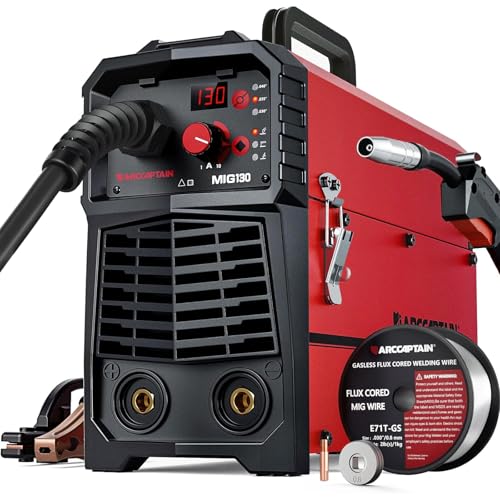
ARCCAPTAIN 130A 110V Multi-Process Welder
Best for: Light home DIY and farm equipment repair
- Welding Process
- TIG, Stick, MIG, Flux Core (what this guide is about)
- Input Voltage
- 110V
- Features
- Synergic Control
- Application
- Home
- Dimensions
- 9 × 6 × 7 inches
- Weight
- 11.8 pounds
View on Amazon: ARCCAPTAIN 130A 110V Multi-Process Welder Affiliate link
This ARCCAPTAIN unit offers 130A output for flux core, stick, and lift TIG welding. It weighs 11.8 pounds and measures 9 by 6 by 7 inches. Synergic control matches wire feed speed to diameter for .030, .035, or .040 inch wire. It runs on 110V input. The compact size and low weight make it easy to carry for home repairs or farm maintenance.
Pros
- 130A max output for light to medium tasks
- Synergic control automates wire feed for ease of use
- Compact 11.8-pound weight with carrying handle
- Includes MIG torch, ground clamp, and flux core wire
Cons
- 110V input limits power for thick metal
- Lift TIG requires purchasing a separate torch
- No digital display for precise parameter reading
Good fit if
- You need a portable welder for light home repairs
- You primarily use flux core wire on thin steel
- You want simple synergic control for learning
Skip if
- You require 220V input for higher amperage
- You need professional-grade TIG capabilities
- You weld thick structural steel regularly
Verdict: ARCCAPTAIN 130A Flux Core Welder fits hobbyists needing a lightweight, easy-to-use machine for thin metal repairs. It is not suitable for heavy industrial work or high-amperage applications.

YESWELDER 200A Dual-Pulse Multi-Process Welder
Best for: Advanced users needing thin metal precision
- Welding Process
- TIG, Stick, MIG, Flux Core, Multi-Process (what this guide is about)
- Amperage
- 200A
- Input Voltage
- Dual Voltage
- Features
- Pulse, Spool Gun, Spot Welding, Digital Display
View on Amazon: YESWELDER 200A Dual-Pulse Multi-Process Welder Affiliate link
This multiprocess welder offers 200 amps and supports MIG, flux core, stick, and lift TIG. It features DualPulse technology for thin metals and a 7-inch LCD screen. Smart parameter matching adjusts settings automatically. You get 50 memory channels for quick setup. It is a versatile tool for users needing precise control over various welding tasks and materials.
Pros
- 200A amperage for heavy-duty work
- DualPulse MIG technology for thin materials
- 7-inch LCD with intuitive interface
- 50 memory channels for quick recall
- Smart parameter matching reduces setup time
Cons
- Lift TIG and spool gun sold separately
- Bulky at 17.32 inches in height
- Requires additional torch for TIG welding
Good fit if
- You need precise control over thin aluminum
- You want to save time on setup
- You prefer a large display screen
Skip if
- You already have a dedicated TIG setup
- You need a compact portable unit
- You only weld thick steel plates
Verdict: YESWELDER DP200 DualPulse MIG Welder suits professionals who need advanced pulse settings and memory storage for varied projects. It is not ideal for those seeking a simple, all-in-one package without extra purchases.

FEMEROL 250A Dual-Voltage Multi-Process MIG Welder
Best for: Versatile fabrication with digital control
- Welding Process
- TIG, Stick, MIG, Flux Core, Multi-Process (what this guide is about)
- Amperage
- 250A
- Input Voltage
- Dual Voltage
- Features
- Spool Gun, Synergic Control
View on Amazon: FEMEROL 250A Dual-Voltage Multi-Process MIG Welder Affiliate link
The FEMEROL MIG250PRO-HM is a 250A multiprocess welder supporting MIG, flux core, stick, spot, and lift TIG welding. It features dual 110V/220V input and a digital LED display for real-time current monitoring. The package includes a helmet with blue light protection. This unit suits users needing versatile capabilities for steel and aluminum, with options for both 2LB and 10LB wire spools.
Pros
- 250A output for thick and thin workpieces
- Dual 110V/220V input voltage
- Digital LED display for real-time current
- Synergic and manual MIG settings
- Includes blue light protection helmet
Cons
- TIG and spool guns not included
- No mention of duty cycle ratings
- Heavier build due to included helmet
Good fit if
- You need a single machine for MIG, stick, and TIG
- You work with both 110V and 220V power sources
- You want immediate eye protection with your purchase
Skip if
- You require a dedicated TIG setup with included torch
- You prefer analog dials over digital displays
- You only perform light DIY flux core welding
Verdict: FEMEROL 250A Multi-Process Welder fits fabricators who want versatile process options and clear digital readouts without buying separate accessories. It is a practical tool for shops that switch between steel and aluminum frequently.

ARCCAPTAIN 220A Stick and Lift TIG Welder
Best for: portable stick welding and outdoor repairs
- Welding Process
- TIG, Stick (what this guide is about)
- Input Voltage
- Dual Voltage
- Features
- Synergic Control, IGBT Inverter, Digital Display, Hot Start, Arc Force
- Application
- Home
- Dimensions
- 15.4 × 6.3 × 13 inches
View on Amazon: ARCCAPTAIN 220A Stick and Lift TIG Welder Affiliate link
The ARCCAPTAIN 220A Stick Welder handles arc and lift TIG processes on 110V or 220V power. It features a 3.2-inch LED display and adjustable hot start and arc force settings. Weighing 9.5 lbs, it includes a handle and shoulder strap for portability. This machine suits beginners using synergic control and professionals needing digital stability for mild steel and stainless steel.
Pros
- Dual 110V and 220V input voltage compatibility
- 3.2-inch large LED screen for clear parameter reading
- Adjustable hot start (0-60A) and arc force (0-100A)
- Lightweight 9.5 lbs build with carrying handle and strap
- Synergic control automatically matches current and voltage for rod diameter
Cons
- Only supports Stick and Lift TIG, lacking MIG or flux core modes
- Lift TIG torch is sold separately
- Maximum current of 220A is lower than the 250A capacity of other machines on this list
Good fit if
- You need a portable unit for outdoor maintenance or farm work
- You primarily weld mild steel or stainless steel with stick electrodes
- You want a machine with adjustable arc force and hot start
Skip if
- You require MIG or flux core welding capabilities
- You need a high-amperage machine for thick plate fabrication
- You want a complete Lift TIG setup without buying extra parts
Verdict: The ARCCAPTAIN 220A Stick Welder is a compact, dual-voltage unit ideal for field repairs and DIY projects. It fits users who prioritize portability and precise stick welding control over multi-process versatility.
Specifications side by side
| Spec | YESWELDER 205A Dual-Voltage Multi-Process Welder | BESTMIG 250A Pulse MIG Welder | ARCCAPTAIN 130A 110V Multi-Process Welder | YESWELDER 200A Dual-Pulse Multi-Process Welder | FEMEROL 250A Dual-Voltage Multi-Process MIG Welder | ARCCAPTAIN 220A Stick and Lift TIG Welder |
|---|---|---|---|---|---|---|
| Welding Process | TIG, Stick, MIG, Flux Core | TIG, Stick, MIG, Flux Core, Multi-Process | TIG, Stick, MIG, Flux Core | TIG, Stick, MIG, Flux Core, Multi-Process | TIG, Stick, MIG, Flux Core, Multi-Process | TIG, Stick |
| Amperage | 205A | 250A | not stated | 200A | 250A | not stated |
| Input Voltage | Dual Voltage | Dual Voltage | 110V | Dual Voltage | Dual Voltage | Dual Voltage |
| Material | not stated | Aluminum | not stated | not stated | not stated | not stated |
| Features | Spool Gun | Pulse, Spool Gun, Digital Display | Synergic Control | Pulse, Spool Gun, Spot Welding, Digital Display | Spool Gun, Synergic Control | Synergic Control, IGBT Inverter, Digital Display, Hot Start, Arc Force |
| Application | not stated | not stated | Home | not stated | not stated | Home |
| Weight | not stated | 15 pounds | 11.8 pounds | not stated | not stated | not stated |
| Dimensions | not stated | not stated | 9 × 6 × 7 inches | not stated | not stated | 15.4 × 6.3 × 13 inches |
| Size | 20 x 16 x 14 inches | MIG Welder 250P | 130A | 17.32×9.45×16.14 in | not stated | ARC220 |
| Color | Black, Red | Red | Red+black | Black, Red | Black | Red&black |
| Model | MIG-205DS PRO | 250P Mig Welder | MIG130 | DP200 | MIG250PRO-HM | ARC220 |
Frequently asked questions
What is the difference between MIG and flux core welding processes?
MIG welding uses a continuous wire feed and shielding gas to protect the weld pool from contamination. Flux core welding also uses a continuous wire but contains a flux agent inside the core. This flux creates the shielding gas, so you do not need external gas tanks. Flux core is often preferred for outdoor work because wind does not disrupt the shielding as easily as it does with MIG.
Can a single welder handle both TIG and Stick processes?
Yes, multi-process welders are designed to handle multiple methods in one unit. The ARCCAPTAIN 220A supports both TIG and Stick welding, making it suitable for portable field repairs. The YESWELDER 205A Dual-Voltage model offers TIG, Stick, MIG, and Flux Core capabilities. These machines switch between processes by changing the torch or electrode holder and adjusting the control settings.
Why is amperage important when choosing a welding process?
Amperage determines the heat input and the thickness of metal you can weld. Higher amperage allows you to penetrate thicker materials and weld faster. For example, the BESTMIG 250A and FEMEROL 250A offer 250 amps for heavy fabrication. The ARCCAPTAIN 130A provides 130 amps, which is better suited for light home DIY tasks and thin metal repairs.
What does dual voltage input mean for a welder?
Dual voltage input allows the machine to operate on different power sources, typically 110V and 220V. This flexibility lets you use the welder in a home garage on standard outlets or in a shop with high-power circuits. Models like the YESWELDER 205A and BESTMIG 250A feature dual voltage. This spec ensures you can run higher amperage settings when needed without upgrading your electrical system.
Is a spool gun necessary for welding aluminum?
A spool gun is highly recommended for welding aluminum because the soft metal can jam in standard MIG liners. The spool gun feeds the wire directly from a small spool near the torch, reducing friction. The YESWELDER 205A and BESTMIG 250A include spool gun support. This feature helps you achieve cleaner, more consistent welds on aluminum projects without frequent wire feeding issues.
How does pulse welding improve the welding process?
Pulse welding alternates between peak and background amperage to control heat input precisely. This technique reduces distortion and spatter, making it ideal for thin metals. The BESTMIG 250A and YESWELDER DP200 feature pulse capabilities. These settings allow you to weld delicate materials with better control. Pulse is particularly useful for aluminum and stainless steel where heat management is critical for quality results.
What size welder is best for portable outdoor repairs?
For portable outdoor work, you need a compact unit with manageable weight and dual voltage support. The ARCCAPTAIN 220A Stick Welder is designed for field repairs and DIY projects. It weighs little and fits easily into a truck. Its compact size and dual voltage input make it a practical choice for users who prioritize portability and precise stick welding control over multi-process versatility.