Input Voltage Explained: What It Means for Welders
As an Amazon Associate we earn from qualifying purchases. Links on this page are affiliate links.
Input Voltage Explained for Welders
Input voltage explained reveals how a welder connects to your power source. This spec defines the electrical potential required to operate the machine. You must match this requirement to your available outlets. Using the wrong voltage can damage the unit or prevent it from starting.
Most home workshops rely on standard 120V circuits. These are common in residential garages. Welders rated for 120V plug into standard three-prong outlets. They are ideal for light repair work and thin materials. However, they deliver lower amperage. This limits their ability to run continuously at high settings.
Industrial and serious hobbyist machines often require 220V or 240V. These voltages come from heavy-duty outlets found in workshops. They provide more power. This allows for higher amperage output. You can weld thicker metals with greater efficiency. The machine runs cooler under heavy loads. This reduces downtime between passes.
Dual voltage models offer flexibility. They can switch between 120V and 240V inputs. This feature is useful if you move between locations. You can use a standard outlet for light tasks. You can switch to a high-power outlet for demanding jobs. Check the switch location. Some models require manual adjustment. Others change automatically.
When shopping, look for these labels on listings. Sellers specify the input range clearly. Do not guess. Verify the outlet type in your space. A 120V welder will not work on a 240V circuit without an adapter, which is not recommended. A 240V welder will not fit a 120V outlet. Ensure your electrical panel has the capacity. Overloading a circuit trips breakers. This stops your work and poses a safety risk.
Understanding this spec saves time and money. It ensures your equipment runs safely. It matches your project needs to your power supply. Always check the nameplate on the machine. The label shows the exact requirements. Follow them strictly for best performance.
Input Voltage Options Compared
Dual Voltage
Dual voltage welders accept multiple input standards, typically 120V and 220V. This flexibility allows you to use the machine on standard household outlets or dedicated high-power circuits. You gain mobility for job sites with limited power but must manage settings to match the source. The YESWELDER 205A Dual-Voltage Multi-Process Welder exemplifies this approach, offering 205A amperage across processes. It suits fabricators needing versatility. However, you may need to switch plugs or internal configurations. This option reduces the risk of being unable to plug in, making it a practical choice for users who move between locations or work in varied environments.
120V
120V input connects to standard North American household outlets. This voltage is common in homes and light workshops. Machines with this spec are often lighter and more portable. The Lincoln Electric Weld-Pak 90i Wire Feed Welder uses 120V input. It is designed for light DIY projects and mobile repairs. You benefit from easy setup without needing special electrical work. The trade-off is lower amperage capacity. You cannot run thick electrodes or continuous high-duty cycles. This option suits beginners and hobbyists working on small jobs. It is not ideal for heavy industrial tasks or thick metal fabrication where higher power is essential for penetration and speed.
220V
220V input requires a dedicated circuit, often found in garages or industrial settings. This voltage provides higher power output, allowing for greater amperage and duty cycles. The ARCCAPTAIN 200A Dual-Voltage Multi-Process Welder is listed with 220V capability. It fits users who have 220V power and need versatile multi-process welding. You get better performance for MIG, flux core, and stick welding on heavier materials. The requirement is a specific outlet, which limits portability. You must ensure your workspace has the correct infrastructure. This option is best for serious hobbyists and professionals who prioritize performance over the convenience of standard plugs.
240V
240V input is a standard for high-power equipment, including plasma cutters and large welders. It delivers consistent power for demanding operations. The ARCCAPTAIN 60A Dual-Voltage Plasma Cutter is listed with 240V input. It is ideal for remote-controlled plasma cutting with air monitoring. You benefit from stable performance for cutting various metals. The machine minimizes prep work with features like rust-cleaning mode. However, you need a 240V outlet, which is not available in all homes. This voltage is common in workshops with dedicated circuits. It suits users who cut thick metal regularly and require precision. The trade-off is the need for specific electrical infrastructure compared to lower voltage options.
Who Needs Dual Voltage Input
Who needs it
You need this spec if you weld in varied locations. Dual voltage units accept 120V for home garages and 220V or 240V for shop circuits. This flexibility lets you start projects without installing new wiring. You can move the welder between sites easily. If you use standard household outlets for light work, the 120V setting works fine. When you need higher amperage for thicker metal, you switch to 220V or 240V. This range covers most residential and light commercial needs. You avoid the hassle of finding specific outlets everywhere. It is ideal for hobbyists who want one machine for all tasks. You gain mobility without sacrificing power when you have access to dedicated circuits. The ability to choose your power source reduces setup time. You are not locked into one type of electrical infrastructure. This adaptability makes daily workflow smoother for mobile or multi-space users.
Who can skip it
You can ignore dual voltage if you only weld in one fixed location. If your shop already has a 220V or 240V outlet, a single-voltage unit is sufficient. You do not need the extra complexity of switching modes. A dedicated high-voltage machine often handles heavier duty cycles better. You prioritize consistent power delivery over mobility. If you never move your welder, the dual voltage feature adds cost without benefit. Focus on duty cycle and amperage instead. These specs determine how long you can weld continuously. You want reliability in your primary workspace. A single-voltage unit simplifies your electrical setup. You avoid confusion about which setting to use. Stick to the voltage your shop provides. This keeps your workflow straightforward and efficient. You save money by skipping unnecessary features. Your priority should be performance at your fixed station, not versatility across different power sources.
Welder Voltage Terms
Amperage
The electrical current flowing through the welder. Higher amperage allows you to weld thicker materials and use larger electrodes for stronger joints.
Duty Cycle
The percentage of time a welder can operate at a set amperage within a ten-minute period. It prevents the machine from overheating during long jobs.
Dual Voltage
The ability to accept multiple input standards, such as 120V and 220V. This flexibility lets you weld in homes or shops without rewiring.
Gauge
A measurement of wire thickness. Lower gauge numbers indicate thicker cables. Thicker cables handle higher current with less voltage drop over distance.
Wattage
The total power consumed by the welder. It equals voltage multiplied by current. You must ensure your circuit can supply this total load.
Circuit Breaker
A safety switch that cuts power if current exceeds safe limits. Tripping indicates the welder draws too much power for your specific outlet.
Arc Voltage
The potential difference between the electrode and workpiece. It stabilizes the arc and influences the heat input and weld bead shape.
Quick picks
| # | Product | Best for | Price |
|---|---|---|---|
| 1 | YESWELDER 205A Dual-Voltage Multi-Process Welder | Versatile fabrication with dual voltage input | Check price of YESWELDER 205A Dual-Voltage Multi-Process Welder on Amazon |
| 2 | Lincoln Electric Weld-Pak 90i Wire Feed Welder | Light DIY projects and mobile repairs | Check price of Lincoln Electric Weld-Pak 90i Wire Feed Welder on Amazon |
| 3 | ARCCAPTAIN 200A Dual-Voltage Multi-Process Welder | 220V users needing versatile multi-process welding | Check price of ARCCAPTAIN 200A Dual-Voltage Multi-Process Welder on Amazon |
| 4 | ARCCAPTAIN 60A Dual-Voltage Plasma Cutter | Remote-controlled plasma cutting with air monitoring | Check price of ARCCAPTAIN 60A Dual-Voltage Plasma Cutter on Amazon |
| 5 | ARCCAPTAIN 50A Dual-Voltage Plasma Cutter | DIYers needing portable dual-voltage cutting | Check price of ARCCAPTAIN 50A Dual-Voltage Plasma Cutter on Amazon |
| 6 | ARCCAPTAIN 145A 3-in-1 Flux Core Welder | Light home DIY and portable repair work | Check price of ARCCAPTAIN 145A 3-in-1 Flux Core Welder on Amazon |
Our 6 picks

YESWELDER 205A Dual-Voltage Multi-Process Welder
Best for: Versatile fabrication with dual voltage input
- Input Voltage
- Dual Voltage (what this guide is about)
- Welding Process
- TIG, Stick, MIG, Flux Core
- Amperage
- 205A
- Features
- Spool Gun
View on Amazon: YESWELDER 205A Dual-Voltage Multi-Process Welder Affiliate link
This YESWELDER unit offers 205A output and handles 110V or 220V input. It supports five processes: MIG, flux core, spool gun, lift TIG, and stick. The digital display shows real-time current, and the machine adjusts voltage automatically when you change wire feed speed. You can fine-tune settings manually or rely on the synergic mode. It fits automotive, construction, and DIY work.
Pros
- 205A maximum amperage for thick materials
- Dual voltage input for 110V or 220V outlets
- Five-in-one welding process capability
- Digital display for real-time current monitoring
Cons
- Requires separate spool gun for aluminum MIG
- Requires separate lift TIG torch
- Bulky at 20 x 16 x 14 inches
Good fit if
- You need a single machine for multiple welding processes
- You work in environments with either 110V or 220V power
- You want digital feedback for precise control
Skip if
- You only weld thin aluminum without buying extra accessories
- You prefer a compact, lightweight unit for tight spaces
- You want a plug-and-play TIG setup without extra purchases
Verdict: YESWELDER 205A Dual Voltage MIG Welder fits fabricators who need high amperage and process flexibility in one dual-voltage package. It suits professionals who value digital control over manual guesswork.

Lincoln Electric Weld-Pak 90i Wire Feed Welder
Best for: Light DIY projects and mobile repairs
- Input Voltage
- 120V (what this guide is about)
- Welding Process
- MIG, Flux Core
- Dimensions
- 10 × 10 × 10 inches
- Weight
- 19 pounds
View on Amazon: Lincoln Electric Weld-Pak 90i Wire Feed Welder Affiliate link
The Lincoln Electric 90i is a compact 120V MIG and flux core welder designed for portability. It weighs 19 pounds and measures 10x10x10 inches. This unit operates on standard household power, making it easy to use anywhere. It features simple dual-knob controls for wire speed and voltage. The machine handles flux-cored wire up to 1/4 inch and solid MIG wire up to 3/16 inch. It includes a full accessory kit and a protective metal case.
Pros
- 120V input voltage for standard outlet use
- Compact 10x10x10 inch footprint and 19 lb weight
- Dual-knob control for wire speed and voltage
- Includes welding gun, nozzle, contact tip, and clamp
- Inverter design for efficient operation
Cons
- Limited to 120V input, not dual voltage
- Max thickness of 3/16 inch for solid MIG wire
- No digital display for precise parameter settings
Good fit if
- You need a welder for light DIY or hobbyist projects
- You require a portable unit for mobile maintenance work
- You have access to standard 120V household outlets
Skip if
- You frequently weld materials thicker than 3/16 inch
- You need to plug into 220V or 240V outlets
- You require dual-voltage flexibility for different power sources
Verdict: Lincoln Electric 90i 120V MIG Welder is a practical, portable solution for beginners and hobbyists working on small jobs. It suits you if you prioritize easy setup and mobility over high-amperage capacity.

ARCCAPTAIN 200A Dual-Voltage Multi-Process Welder
Best for: 220V users needing versatile multi-process welding
- Input Voltage
- 220V (what this guide is about)
- Welding Process
- TIG, Stick, MIG, Flux Core
- Amperage
- 200A
- Material
- Aluminum
- Features
- Spool Gun, Spot Welding
- Dimensions
- 3.54 × 2.36 × 2.76 inches
View on Amazon: ARCCAPTAIN 200A Dual-Voltage Multi-Process Welder Affiliate link
The ARCCAPTAIN MIG200 is a 200-amp multi-process welder supporting MIG, flux core, stick, spot welding, and lift TIG. It operates on 220V input voltage, which provides higher power for thicker materials compared to 120V units. The digital control panel features a large LED display and stores 10 preset settings for each welding mode. This machine includes adaptive crater and burn-back adjustments to improve weld quality.
Pros
- 200A output capacity for robust welding performance
- 6-in-1 multi-process capability including MIG, flux core, and stick
- Large LED display for clear parameter reading
- Stores 10 preset settings per welding mode
- Includes cooling fan that runs only when needed
Cons
- Requires 220V input voltage, limiting use on standard 120V outlets
- Spool gun and TIG gun are not included
- Separate rollers are needed for .023” and .040” wires
Good fit if
- You need a 220V machine for thicker materials
- You want a single unit for multiple welding processes
- You prefer digital presets for consistent settings
Skip if
- You only have access to 120V household outlets
- You need a ready-to-use TIG or spool gun setup
- You require a lighter, more portable 120V unit
Verdict: ARCCAPTAIN MIG200 200A 6-in-1 Welder fits professionals or serious hobbyists who have 220V power and need a versatile machine for heavy-duty MIG, flux core, and stick welding tasks.
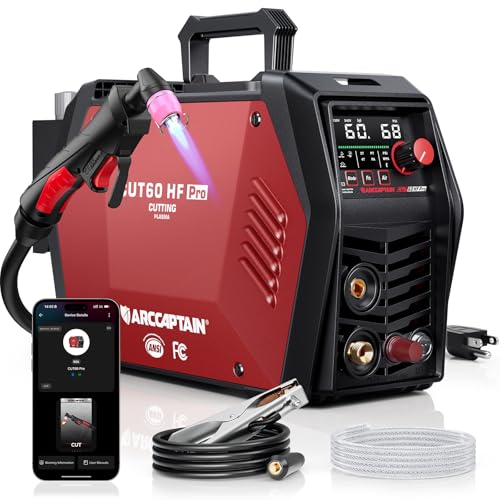
ARCCAPTAIN 60A Dual-Voltage Plasma Cutter
Best for: Remote-controlled plasma cutting with air monitoring
- Input Voltage
- 240V (what this guide is about)
- Features
- Plasma Cutter, Digital Display
View on Amazon: ARCCAPTAIN 60A Dual-Voltage Plasma Cutter Affiliate link
This 60-amp plasma cutter handles 120V and 240V input. It cuts up to 16 mm on 120V and 26 mm on 240V. The app lets you control settings from 10 meters away. An intelligent air-pressure monitor prevents errors. It includes a pilot arc rust-cleaning mode. This unit suits users who need remote control and precise cutting on various metals.
Pros
- Dual 120V/240V input for flexible power options
- App control allows operation from up to 10 meters away
- Intelligent air-pressure monitoring displays real-time data and alerts
- Pilot arc rust-cleaning mode removes oxidation without damaging base metal
Cons
- Requires external air compressor to operate
- No mention of included consumables or torch in specifications
- App functionality depends on smartphone compatibility and connectivity
Good fit if
- You need precise control over cutting settings from a distance
- You work with stainless steel, aluminum, or copper and want smooth edges
- You want real-time air-pressure monitoring to prevent operational errors
Skip if
- You require a single-voltage unit for simple plug-and-play use
- You do not have access to a compatible smartphone app
- You need a machine that includes all consumables in the box
Verdict: ARCCAPTAIN CUT60 Pro Plasma Cutter fits users who value remote app control and precise air-pressure management. It is ideal for those who cut various metals and want to minimize prep work with its rust-cleaning mode.
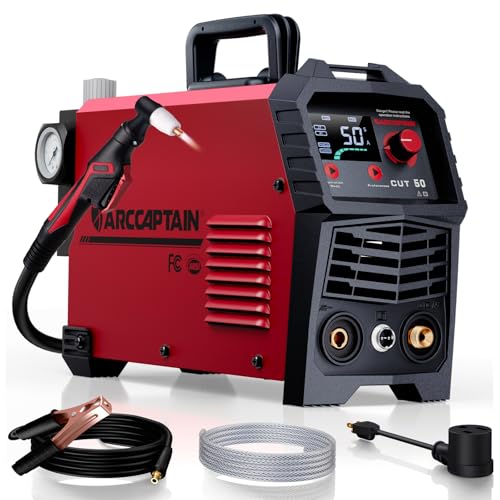
ARCCAPTAIN 50A Dual-Voltage Plasma Cutter
Best for: DIYers needing portable dual-voltage cutting
- Input Voltage
- Dual Voltage (what this guide is about)
- Features
- IGBT Inverter, Plasma Cutter, Digital Display
- Dimensions
- 13 × 6 × 8 inches
- Weight
- 13 pounds
View on Amazon: ARCCAPTAIN 50A Dual-Voltage Plasma Cutter Affiliate link
The ARCCAPTAIN CUT50 is a 50A plasma cutter that supports dual voltage input, switching between 110V and 220V. It cuts up to 1/2 inch on steel and features an LED screen for real-time data. Weighing 13 lbs, it includes a shoulder strap for portability. You get adjustable post-flow cooling and a smart fan system. It requires a separate air compressor.
Pros
- Dual voltage input for 110V or 220V operation
- LED screen displays voltage and current in real time
- Weighs 13 lbs with a shoulder strap for portability
- Smart fan reduces noise by up to 30%
Cons
- Requires a separate air compressor
- Compressor not included in the package
- Maximum cut thickness is 1/2 inch
Good fit if
- You need a portable cutter for job sites
- You want dual voltage flexibility for home or shop
- You prefer real-time data on an LED screen
Skip if
- You need to cut thicker than 1/2 inch steel
- You do not have an air compressor available
- You want a pilot arc model for dirty metal
Verdict: The ARCCAPTAIN CUT50 Plasma Cutter fits DIYers who need a lightweight, dual-voltage tool for thin to medium gauge metal. It is ideal for clean cuts on steel, aluminum, or copper in tight spaces.

ARCCAPTAIN 145A 3-in-1 Flux Core Welder
Best for: Light home DIY and portable repair work
- Input Voltage
- 120V (what this guide is about)
- Welding Process
- TIG, Stick, MIG, Flux Core
- Features
- Synergic Control
- Application
- Home
- Dimensions
- 14.9 × 5.3 × 9.7 inches
- Weight
- 10 pounds
View on Amazon: ARCCAPTAIN 145A 3-in-1 Flux Core Welder Affiliate link
The ARCCAPTAIN MIG145 Pro is a 120V flux core MIG welder designed for home DIY and small repairs. It features a 145A output and three welding modes: Gasless MIG, MMA, and Lift TIG. The unit includes a large LED display for easy parameter reading and a smartphone app for remote control. Weighing 10 pounds, it is compact and portable, making it suitable for outdoor jobs and farm equipment maintenance.
Pros
- 120V input voltage for standard household outlets
- 145A welding output capacity
- Smartphone app control for remote settings
- Large LED display for clear parameter reading
- Lightweight 10-pound design with shoulder strap
Cons
- Lift TIG torch sold separately
- Single 120V input limits industrial use
- Lower amperage than 200A+ models
Good fit if
- You need a welder for light home repairs
- You want remote app control for settings
- You require a portable unit for outdoor jobs
Skip if
- You need dual voltage for 220V outlets
- You weld thick structural steel regularly
- You require a complete Lift TIG setup
Verdict: ARCCAPTAIN MIG145 Pro 120V Flux Core Welder fits hobbyists who need a lightweight, app-controlled machine for thin metal repairs. It is not suitable for heavy industrial work or users without 120V access.
Specifications side by side
| Spec | YESWELDER 205A Dual-Voltage Multi-Process Welder | Lincoln Electric Weld-Pak 90i Wire Feed Welder | ARCCAPTAIN 200A Dual-Voltage Multi-Process Welder | ARCCAPTAIN 60A Dual-Voltage Plasma Cutter | ARCCAPTAIN 50A Dual-Voltage Plasma Cutter | ARCCAPTAIN 145A 3-in-1 Flux Core Welder |
|---|---|---|---|---|---|---|
| Welding Process | TIG, Stick, MIG, Flux Core | MIG, Flux Core | TIG, Stick, MIG, Flux Core | not stated | not stated | TIG, Stick, MIG, Flux Core |
| Amperage | 205A | not stated | 200A | not stated | not stated | not stated |
| Input Voltage | Dual Voltage | 120V | 220V | 240V | Dual Voltage | 120V |
| Material | not stated | not stated | Aluminum | not stated | not stated | not stated |
| Features | Spool Gun | not stated | Spool Gun, Spot Welding | Plasma Cutter, Digital Display | IGBT Inverter, Plasma Cutter, Digital Display | Synergic Control |
| Application | not stated | not stated | not stated | not stated | not stated | Home |
| Dimensions | not stated | 10 × 10 × 10 inches | 3.54 × 2.36 × 2.76 inches | not stated | 13 × 6 × 8 inches | 14.9 × 5.3 × 9.7 inches |
| Weight | not stated | 19 pounds | 14.1 ounces | not stated | 13 pounds | 10 pounds |
| Size | 20 x 16 x 14 inches | not stated | 20.9" x 8.5" x 16.1" | CUT60 Pro | CUT50 110V/220V | not stated |
| Color | Black, Red | Solid Black | Red+black | not stated | Red | Red+black |
| Model | MIG-205DS PRO | K5256-1 | MIG200 | CUT60 Pro | CUT50 | MIG145-PRO |
Frequently asked questions
Can I plug a 120V welder into a standard household outlet?
Yes, 120V welders are designed for standard household outlets. The Lincoln Electric Weld-Pak 90i operates on 120V, making it suitable for beginners and hobbyists. This voltage allows for easy setup and mobility for light DIY projects. You do not need to install specialized wiring to use these units in your home garage.
What is the difference between 220V and 240V input voltage?
Both 220V and 240V refer to high-power circuits used for heavier welding tasks. The ARCCAPTAIN MIG200 accepts 220V input, while the ARCCAPTAIN CUT60 Pro requires 240V. These voltages provide the necessary power for professional-grade multi-process welding and plasma cutting. You must ensure your shop has the correct dedicated circuit for these machines.
Do dual voltage welders work on both 120V and 220V?
Yes, dual voltage welders accept multiple input standards, typically 120V and 220V. The YESWELDER 205A and ARCCAPTAIN CUT50 both support dual voltage. This flexibility lets you use standard household outlets or dedicated high-power circuits. You gain mobility for job sites with limited power while retaining the ability to run at higher amperages when connected to 220V.
Is dual voltage better for mobile welding jobs?
Dual voltage is ideal for mobile welding because it adapts to different power sources. The YESWELDER 205A offers 205A amperage with dual voltage input, fitting fabricators who need high power and flexibility. You can move the welder between home garages and job sites without worrying about incompatible outlets. This spec supports professionals who value versatile power options.
Can I use a 240V plasma cutter on a 120V outlet?
No, a 240V plasma cutter requires a dedicated 240V circuit. The ARCCAPTAIN CUT60 Pro is listed with 240V input voltage. Plugging it into a 120V outlet will not provide the necessary power for operation. You must match the input voltage spec to your available outlets to avoid damaging the unit or failing to cut metal effectively.
Which welder is best for thin metal repairs at home?
The ARCCAPTAIN MIG145 Pro is a 120V flux core welder suited for light home DIY. It weighs only 10 pounds and operates on standard household power. This unit fits hobbyists who need a lightweight, app-controlled machine for thin metal repairs. It is not suitable for heavy industrial work but offers portability for small jobs.