Features in Welders: What It Is and Is It Worth It?
As an Amazon Associate we earn from qualifying purchases. Links on this page are affiliate links.
Welder Features Explained for Buyers
Understanding welder features explained helps you match equipment to your specific projects. These specifications define what the machine can do and how it performs under different conditions. You should look at each feature to see if it fits your workflow.
Pulse welding delivers short bursts of current. This controls heat input on thin materials. It prevents burn-through on aluminum or steel sheets. You will see pulse frequency and background current settings in the data.
A spool gun feeds filler wire directly from a small reel. This reduces tangle issues with soft aluminum wire. Standard guns often jam when pushing soft wire long distances. If you plan to weld aluminum frequently, this accessory is essential for consistent results.
Spot welding joins two sheets of metal at a single point. It creates strong, clean joints without a continuous weld bead. This is common in automotive repair and sheet metal fabrication. Look for dedicated spot welding capabilities or compatible attachments in the specs.
Synergic control links parameters automatically. When you select material thickness, the machine sets voltage and wire speed. This simplifies setup for beginners. It ensures optimal settings are used for each material type.
IGBT inverter technology replaces older transformer designs. It makes the unit lighter and more efficient. These inverters offer precise current control and faster response times. Most modern welders use this technology for better performance.
A plasma cutter cuts through conductive metals using a plasma torch. It is not for welding but for cutting steel, stainless steel, or aluminum. Check the amperage rating to determine maximum cutting thickness.
A foot pedal allows hands-free control of amperage. You adjust the current while keeping both hands on the torch or workpiece. This provides better stability and precision, especially for TIG welding. Some models integrate the pedal, while others require a separate purchase.
Key Welder Features Compared
Pulse
Pulse welding sends rapid bursts of current instead of a steady stream. This reduces heat input, helping you weld thin metals without burning through them. It improves control over the weld pool, making vertical or overhead positions easier. The BESTMIG 250A Pulse MIG Welder offers stable pulse performance for these tasks. You should choose this if you work with aluminum or thin steel. The trade-off is that pulse settings can be complex to dial in compared to standard modes. It is ideal for precision work rather than fast, heavy builds.
Spool Gun
A spool gun holds a small wire spool close to the torch to prevent birdnesting. This is essential when welding aluminum because soft wire jams easily in long liner tubes. The YESWELDER 205A Dual-Voltage Multi-Process Welder includes this capability. The BESTMIG 250A also supports it. Using a spool gun adds bulk and weight to your setup. You must manage an extra wire spool. However, it ensures smooth wire feeding for non-ferrous metals. Without it, aluminum MIG welding can be frustrating and unreliable for regular use.
Spot Welding
Spot welding creates small, localized welds at specific points rather than continuous seams. This is useful for tack welding or joining thin sheets where a full bead is unnecessary. It saves time and reduces heat distortion on delicate materials. The Weldpro 140A Dual-Voltage Multi-Process Welder includes this function. The YESWELDER 200A Pulse MIG Welder also offers spot welding capabilities. You should use this for quick tacks or automotive repair. The trade-off is that it is not suitable for long, continuous joints. It is a specialized tool for specific, short-duration applications.
Synergic Control
Synergic control automatically sets parameters like wire speed and voltage based on your material thickness and type. You select the material and thickness, and the machine calculates the rest. This simplifies setup for beginners or those who want consistent results without manual tuning. The Weldpro 140A Synergic Welder uses this approach. It fits users who value ease over manual precision. The trade-off is less granular control for experienced welders. You cannot fine-tune every variable independently. This feature is best for general fabrication and DIY work.
IGBT Inverter
IGBT inverters use advanced switching technology to convert power efficiently. This makes the welder lighter, smaller, and more energy-efficient than older transformer-based models. You get better arc stability and faster response times. The Weldpro 140A uses an IGBT inverter. This allows for a compact design weighing only 7.5 pounds. The trade-off is that inverters can be more sensitive to dust and moisture. You must keep the unit clean and dry. This technology is standard in modern welders, offering portability for light to medium duty work.
Plasma Cutter
Plasma cutting uses a constricted arc of ionized gas to melt and blow away metal. It is not a welding process but a cutting one. You use it to slice through conductive metals like steel, stainless steel, and aluminum. The ARCCAPTAIN 50A Dual-Voltage Plasma Cutter is designed for this. It offers portable cutting power in a compact size. The trade-off is that you need a clean air supply and compressor. Plasma cutting creates a different edge quality than mechanical cutting. It is ideal for shaping metal or removing bad welds, but does not replace welding for joining materials.
Is This Welder Worth Your Money
Who needs it
You need this machine if your projects involve thin sheet metal or require high-precision joins. The pulse feature reduces heat input, preventing burn-through on delicate materials. Synergic control simplifies settings by automatically matching parameters, which helps you achieve consistent results without extensive trial and error. If you work with aluminum, the included spool gun is essential for feeding soft wire smoothly. The foot pedal gives you real-time amperage adjustment, allowing precise control over the weld pool size. This combination is ideal for fabrication shops, automotive repair, or artistic metalwork where detail matters. You also benefit from the plasma cutter if you frequently cut through steel plate before welding. The IGBT inverter ensures stable performance across various duties. This setup saves time and reduces the learning curve for complex tasks. You get versatility in one unit, handling MIG, TIG, and plasma cutting needs without switching equipment. It is a comprehensive tool for serious hobbyists or professionals who demand accuracy and efficiency in diverse applications.
Who can skip it
You can skip this model if you only weld thick structural steel or perform simple repairs. Basic MIG welding on heavy gauge metal does not require pulse or synergic controls. The added complexity of foot pedals and spool guns may hinder your workflow if you stick to standard stick or basic MIG processes. The plasma cutter adds weight and bulk, which is unnecessary if you never cut metal. IGBT inverters are common now, so paying extra for this specific architecture offers no distinct advantage for straightforward jobs. You should prioritize durability and duty cycle over advanced features like spot welding or precise heat control. A simpler, lighter machine will be easier to transport and store. Focus on raw amperage and reliability instead of specialized functions you will not use. The cost of these extras does not benefit users who perform repetitive, heavy-duty work. You get better value from a no-frills unit that delivers consistent power without unnecessary bells and whistles. Keep it simple if your needs are basic.
Welder Feature Glossary
Welding Process
The method used to join metals, such as MIG, TIG, or Stick. Each process uses different heat sources and filler materials to create strong, permanent bonds between workpieces.
Amperage
The electrical current strength, measured in amps. Higher amperage allows you to weld thicker materials. Typical machines range from 140 to 200 amps for home and shop use.
Input Voltage
The power source required to run the welder, usually 110V or 220V. Higher voltage provides more power for thick metals but requires a specific outlet in your workshop.
Material Type
The metal the machine is designed to join, such as steel, stainless steel, or aluminum. Some welders handle multiple materials, while others are specialized for just one type.
Current Type
Whether the machine outputs Direct Current (DC) or Alternating Current (AC). DC is standard for most metals, while AC is primarily used for welding aluminum to clean oxides.
Wattage
The power consumption rate, calculated from voltage and amperage. It determines how much energy the unit draws from your outlet. Higher wattage supports continuous operation on thick materials.
Application
The intended use case, such as automotive repair, structural fabrication, or artistic metalwork. Your application dictates the required duty cycle and portability needs for your specific projects.
Quick picks
| # | Product | Best for | Price |
|---|---|---|---|
| 1 | BESTMIG 250A Pulse MIG Welder | Aluminum welding with pulse control | Check price of BESTMIG 250A Pulse MIG Welder on Amazon |
| 2 | YESWELDER 205A Dual-Voltage Multi-Process Welder | versatile MIG and flux core tasks | Check price of YESWELDER 205A Dual-Voltage Multi-Process Welder on Amazon |
| 3 | YESWELDER 200A Pulse MIG Welder | Aluminum MIG and spot welding tasks | Check price of YESWELDER 200A Pulse MIG Welder on Amazon |
| 4 | ARCCAPTAIN 50A Dual-Voltage Plasma Cutter | Portable cutting with digital feedback | Check price of ARCCAPTAIN 50A Dual-Voltage Plasma Cutter on Amazon |
| 5 | Sunstac 250A AC/DC Pulse TIG Welder | Aluminum TIG welding with pulse control | Check price of Sunstac 250A AC/DC Pulse TIG Welder on Amazon |
| 6 | Weldpro 140A Dual-Voltage Multi-Process Welder | light DIY and portable home repair welding | Check price of Weldpro 140A Dual-Voltage Multi-Process Welder on Amazon |
Our 6 picks

BESTMIG 250A Pulse MIG Welder
Best for: Aluminum welding with pulse control
- Features
- Pulse, Spool Gun, Digital Display (what this guide is about)
- Welding Process
- TIG, Stick, MIG, Flux Core, Multi-Process
- Amperage
- 250A
- Input Voltage
- Dual Voltage
- Material
- Aluminum
- Weight
- 15 pounds
View on Amazon: BESTMIG 250A Pulse MIG Welder Affiliate link
This BESTMIG unit offers 250A output with pulse MIG and spool gun support for aluminum welding. It features dual voltage input and a large LED display for easy monitoring. The digital controls include 2T/4T modes to reduce fatigue. It weighs 15 pounds and includes a helmet and gloves. It suits fabricators needing versatile process options and precise heat control for thin metals.
Pros
- 250A output handles mild steel, stainless steel, and aluminum
- Pulse MIG mode prevents burn-through on aluminum
- Large LED display shows parameters without helmet removal
- Dual voltage 110V/220V auto-recognition
- Includes auto-darkening helmet and gloves
Cons
- Lift TIG torch and reel gun sold separately
- IP21S rating limits outdoor wet use
- Class F insulation may limit extreme heat tolerance
Good fit if
- You weld aluminum and need pulse control
- You want a large display for parameter checks
- You need dual voltage for home or shop
Skip if
- You require integrated TIG torch in the box
- You need industrial-grade weatherproofing
- You prefer analog dials over digital displays
Verdict: BESTMIG 250A 8-in-1 MIG Welder fits aluminum welders who value digital precision and included accessories. It delivers stable pulse performance for thin metals without the bulk of heavier industrial units.

YESWELDER 205A Dual-Voltage Multi-Process Welder
Best for: versatile MIG and flux core tasks
- Features
- Spool Gun (what this guide is about)
- Welding Process
- TIG, Stick, MIG, Flux Core
- Amperage
- 205A
- Input Voltage
- Dual Voltage
View on Amazon: YESWELDER 205A Dual-Voltage Multi-Process Welder Affiliate link
The YESWELDER 205A MIG Welder handles five processes: Gas MIG, Flux Core, Spool Gun, Lift TIG, and Stick. It delivers 205 amps on 110V or 220V power. Synergic control adjusts voltage as you change wire speed. A digital display shows real-time current. This unit suits beginners and pros who need one machine for steel, aluminum, and stainless steel.
Pros
- 5-in-1 process versatility
- 205A output capacity
- Synergic MIG control
- Digital current display
Cons
- No pulse MIG capability
- No foot pedal included
- Lift TIG requires extra torch
Good fit if
- You need a single machine for multiple materials
- You want synergic voltage adjustment
- You weld steel and aluminum
Skip if
- You require precise pulse control
- You need a foot pedal
- You want integrated spool gun
Verdict: The YESWELDER 205A MIG Welder fits users who prioritize process variety and synergic ease over advanced pulse features. It is a practical base for fabrication work.

YESWELDER 200A Pulse MIG Welder
Best for: Aluminum MIG and spot welding tasks
- Features
- Pulse, Spool Gun, Spot Welding (what this guide is about)
- Welding Process
- TIG, Stick, MIG, Flux Core
- Amperage
- 200A
View on Amazon: YESWELDER 200A Pulse MIG Welder Affiliate link
The YESWELDER SP200 is a 200A multi-process welder supporting MIG, flux core, spot welding, and spool gun setups. It features pulsed MIG and synergic control, which auto-matches voltage to wire speed. The IntuiWeld LCD interface simplifies adjustments for beginners, while manual modes suit experienced users. This unit handles automotive and fabrication tasks with dual voltage input.
Pros
- 200A output for robust performance
- Pulsed MIG and spot welding capabilities
- Synergic MIG auto-matches voltage
- IntuiWeld LCD screen with knob control
- Spool gun compatible for aluminum
Cons
- Spool gun and lift TIG torch sold separately
- No foot pedal included in base specs
- Heavy build implied by 200A capacity
Good fit if
- You need pulsed MIG for aluminum
- You want synergic MIG automation
- You require spot welding for thin metal
Skip if
- You need a foot pedal included
- You prefer a lighter portable unit
- You only need basic stick welding
Verdict: The YESWELDER SP200 200A MIG Welder fits fabricators needing pulsed MIG and spot welding. It suits users who value synergic automation over manual tuning.
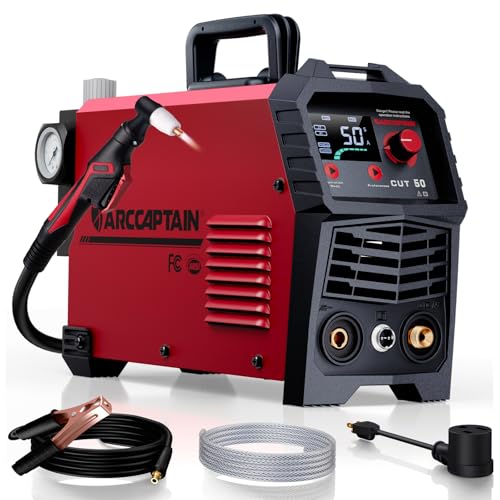
ARCCAPTAIN 50A Dual-Voltage Plasma Cutter
Best for: Portable cutting with digital feedback
- Features
- IGBT Inverter, Plasma Cutter, Digital Display (what this guide is about)
- Input Voltage
- Dual Voltage
- Dimensions
- 13 × 6 × 8 inches
- Weight
- 13 pounds
View on Amazon: ARCCAPTAIN 50A Dual-Voltage Plasma Cutter Affiliate link
This ARCCAPTAIN plasma cutter delivers up to 50 amps of cutting power on 220V and 35 amps on 110V. It features an IGBT inverter for efficient operation and a smart cooling system that reduces noise by 30%. The LED screen displays real-time voltage and current, allowing you to adjust settings without removing your safety helmet. It includes a 1/4" NPT quick connector for air supply. This unit is designed for portable use in workshops or job sites.
Pros
- Dual voltage support for 110V and 220V input
- LED display shows real-time voltage and current data
- Smart fan reduces noise by up to 30%
- Includes 1/4" NPT quick-connect air fitting
Cons
- Requires a separate compressed air source
- Compressor is not included in the package
- Maximum cut thickness is limited to 1/2 inch
Good fit if
- You need a portable cutter for tight spaces
- You want real-time data on an LED screen
- You have access to compressed air
Skip if
- You do not have a compressed air source
- You need to cut material thicker than 1/2 inch
- You prefer a pilot arc model without an LED
Verdict: ARCCAPTAIN CUT50 Plasma Cutter offers a compact, dual-voltage solution for users who need portable cutting power and clear digital feedback. It fits well in workshops where space is limited and air supply is available.

Sunstac 250A AC/DC Pulse TIG Welder
Best for: Aluminum TIG welding with pulse control
- Features
- Pulse, Spot Welding, Foot Pedal (what this guide is about)
- Welding Process
- TIG, Stick
- Amperage
- 250A
- Input Voltage
- Dual Voltage
- Material
- Aluminum
- Current Type
- AC/DC
View on Amazon: Sunstac 250A AC/DC Pulse TIG Welder Affiliate link
This Sunstac unit is a 250A AC/DC TIG welder built for aluminum and alloy steel. It includes pulse TIG and AC spot welding to control heat and reduce distortion. The LCD screen displays voltage and current settings clearly. You get dual voltage support for 110V and 220V operation. A foot pedal is required for variable control, but it is not included in the package.
Pros
- 250A AC/DC output for aluminum and steel
- Pulse TIG mode for precise heat control
- LCD digital screen for clear parameter reading
- AC spot welding for reinforcement
Cons
- Foot pedal is not included
- AC current measurement can be inaccurate
- AC balance variations may affect current readings
Good fit if
- You need AC TIG for aluminum welding
- You want pulse control for thin materials
- You prefer an LCD display for settings
Skip if
- You need a foot pedal included
- You require accurate AC current measurement
- You only weld steel with DC TIG
Verdict: Sunstac 250A AC/DC TIG Welder suits aluminum fabricators who need pulse control and clear digital readouts. You should skip it if you need precise AC current readings or a included foot pedal.
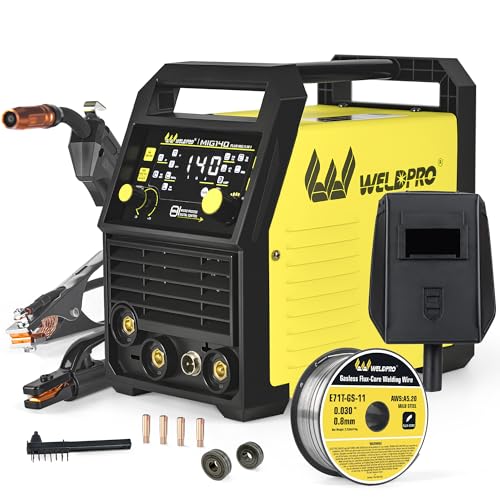
Weldpro 140A Dual-Voltage Multi-Process Welder
Best for: light DIY and portable home repair welding
- Features
- Spot Welding, Synergic Control, IGBT Inverter, Digital Display (what this guide is about)
- Welding Process
- TIG, Stick, MIG, Flux Core
- Amperage
- 140A
- Input Voltage
- Dual Voltage
- Dimensions
- 11.5 × 6.1 × 9.6 inches
- Weight
- 7.5 pounds
View on Amazon: Weldpro 140A Dual-Voltage Multi-Process Welder Affiliate link
The Weldpro MIG140 is a 140A 5-in-1 welder featuring synergic control and spot welding. It uses IGBT inverter technology and automatically detects 110V or 220V input. The digital display and intuitive knobs simplify setup. You get Lift TIG, Stick, and MIG capabilities in a compact 7.5-pound unit. This machine suits DIYers needing versatile, portable welding for home repairs and light workshop tasks.
Pros
- Synergic control automatically adjusts voltage and wire feed speed
- Spot welding capability for thin materials
- Automatic 110V/220V voltage detection
- Compact 7.5-pound weight for portability
- IGBT inverter technology for stable arcs
Cons
- 140A amperage is lower than competitors offering 200A+
- No pulse MIG or TIG pulse functionality listed
- No foot pedal included for TIG control
Good fit if
- You need a lightweight welder for on-the-go jobs
- You want automatic voltage detection for dual-voltage use
- You require synergic control for easier setup
Skip if
- You need high-amperage output for thick steel
- You require pulse MIG for aluminum welding
- You want a foot pedal for TIG precision
Verdict: The Weldpro MIG140 140A Synergic Welder fits beginners or occasional users who value portability and automated settings over high power or advanced TIG features. It is a practical option for light DIY work but not for professional heavy-duty fabrication.
Specifications side by side
| Spec | BESTMIG 250A Pulse MIG Welder | YESWELDER 205A Dual-Voltage Multi-Process Welder | YESWELDER 200A Pulse MIG Welder | ARCCAPTAIN 50A Dual-Voltage Plasma Cutter | Sunstac 250A AC/DC Pulse TIG Welder | Weldpro 140A Dual-Voltage Multi-Process Welder |
|---|---|---|---|---|---|---|
| Welding Process | TIG, Stick, MIG, Flux Core, Multi-Process | TIG, Stick, MIG, Flux Core | TIG, Stick, MIG, Flux Core | not stated | TIG, Stick | TIG, Stick, MIG, Flux Core |
| Amperage | 250A | 205A | 200A | not stated | 250A | 140A |
| Input Voltage | Dual Voltage | Dual Voltage | not stated | Dual Voltage | Dual Voltage | Dual Voltage |
| Material | Aluminum | not stated | not stated | not stated | Aluminum | not stated |
| Current Type | not stated | not stated | not stated | not stated | AC/DC | not stated |
| Features | Pulse, Spool Gun, Digital Display | Spool Gun | Pulse, Spool Gun, Spot Welding | IGBT Inverter, Plasma Cutter, Digital Display | Pulse, Spot Welding, Foot Pedal | Spot Welding, Synergic Control, IGBT Inverter, Digital Display |
| Weight | 15 pounds | not stated | not stated | 13 pounds | not stated | 7.5 pounds |
| Dimensions | not stated | not stated | not stated | 13 × 6 × 8 inches | not stated | 11.5 × 6.1 × 9.6 inches |
| Size | MIG Welder 250P | 20 x 16 x 14 inches | not stated | CUT50 110V/220V | 250A AC/DC Pulsed TIG | 7.5 Pounds |
| Color | Red | Black, Red | Black, Red | Red | Black | not stated |
| Model | 250P Mig Welder | MIG-205DS PRO | SP200 | CUT50 | TIG-250 TP ACDC | MIG140 |
Frequently asked questions
What does a spool gun feature do?
A spool gun holds a small wire spool directly at the torch tip. This setup prevents soft aluminum wire from jamming in the feed mechanism. The YESWELDER 205A and BESTMIG 250A models include this feature, making them suitable for welding aluminum without frequent tangles.
How does spot welding work on a MIG welder?
Spot welding creates localized fusion points rather than continuous beads. This is useful for joining thin sheets without distorting them. The YESWELDER SP200 and Weldpro MIG140 support this function, allowing you to tack metals quickly for assembly tasks or light fabrication work.
What is synergic control in welding machines?
Synergic control automatically matches voltage to wire feed speed. This simplifies setup by reducing the number of manual adjustments needed. The Weldpro MIG140 uses this technology to help beginners achieve consistent results. It is ideal for users who want automated parameter matching.
Why choose a plasma cutter over a standard welder?
Plasma cutters use ionized gas to slice through conductive metals. They provide clean, precise cuts on steel and aluminum. The ARCCAPTAIN CUT50 is a dedicated unit for this purpose. It offers portable cutting power with dual-voltage input for flexible workshop use.
What is the benefit of an IGBT inverter?
IGBT inverters improve energy efficiency and reduce machine weight. They allow for compact designs without sacrificing power output. The Weldpro MIG140 utilizes this technology to stay lightweight at 7.5 pounds. This makes it easier to transport for on-site DIY repairs.
When should I use a foot pedal with a TIG welder?
A foot pedal controls amperage in real time while you weld. This gives you precise heat management for varying joint thicknesses. The Sunstac 250A includes a foot pedal for AC/DC TIG processes. It is essential for aluminum welding where heat control is critical.
What does dual voltage input mean for welders?
Dual voltage input allows the machine to run on 110V or 220V power sources. This provides flexibility for home garages or industrial shops. Most listed models, including the BESTMIG 250A and ARCCAPTAIN CUT50, support this feature. It ensures compatibility with different electrical setups.